carcinization
this is less a blog post and more a full research article, but i prefer to keep all my written material in the same spot rather than rely on third party hosts. so, if you're interested in learning about trends in recent automotive history, read on! the text in the charts are small (sorry, it's hard to fit everything in frame otherwise), but if you click on them they will open fullscreen in a new tab. a link to the github repo for this project is further below, and also separately accessible from the projects page. anyways, see you next time :3
Sorry, this isn't actually about crabs. It's about vehicles. Please stick around, though. I'm going to attempt to answer a similar question in a data-driven manner: Why are most modern vehicles SUVs? And why have a few notable, established model names transformed from cars into SUVs over the past couple decades? I've seen plenty of answers to this question already, but they're all opinion pieces written by car enthusiasts and/or journalists. The most vocal members of this demographic all share the same terminal problem: they like driving too much.
Certain car journalists, much like certain music journalists, belong to an incestuous den mired 50 years in the past. They love whining about how Led Zeppelin and the 1969 Dodge Charger were the pinnacle of mankind, as if the industry could somehow magically return to a narrowly-perceived "golden age" if only they would listen. They indoctrinate their followers, centering themselves as a David of sorts against an amalgamate Goliath comprised of the billions of average consumers and the major auto manufacturers. They blame the death of other vehicle species on buyers favoring SUVs for selfish, narrow-minded reasons such as:
- To assert dominance over other drivers (ride height)
- To drive on an unpaved road once a year (AWD)
- To pack massive bags and travel without any compromises (cargo space + comfort)
- To get more car for their dollar (bigger vehicle = better deal)
And while I won't refute those accusations because on average we as humans are remarkably stupid, I also think their interpretation suits their own vitriolic, anachronistic narrative while downplaying the real priorities and motivations of modern car owners. So let's find a more honest answer together.
Preface: What's An SUV?
There are a lot of definitions, most of which blur together and many of which will light chatrooms ablaze with furious typing. You may be familiar with the modern term "crossover", whose usage is now so slipshod in application by automakers, enthusiasts, and consumers alike that it has lost all definition whatsoever. Look no further than Subaru's own website featuring a litany of SUVs, several of which are labelled as "Compact Crossover SUV". Right, right, whatever you say. Now let's back away, slowly and quietly so as not to alarm the Subaru fans.
Instead of miring ourselves in messing with redefining an SUV, I propose we create a new bin. One theory of why carcinization occurs in sea creatures is due to the survival and utility advantages provided by crab-like characteristics. Species which are lucky enough to evolve these features gain a competitive edge in their environments, making it more likely for them to live, reproduce, and further carcinize in situations where other species may die. Let's consider the capitalist vehicle market an environment for our thought experiment. The more units a particular vehicle sells, the better that vehicle's odds are of living for another model year. If a manufacturer wants to create a new vehicle that's a secure return on investment, their best bet is a design that appeals to the widest possible audience. In an increasingly competitive market, design converges upon established successful standards. Therefore, why not consider SUVs, crossovers, and other such utility-focused vehicles as "Crabs"? A group of species which, in order to adapt to their environment, have tailored their forms to maximize utility for end users' specific needs.
In this paradigm, a Crab does not need a body-on-frame chassis. It doesn't even need to be a minimum size. The first generation Subaru Forester is dimensionally a hatchback in today's market, yet is legally registered and insured as an SUV and was marketed as one.
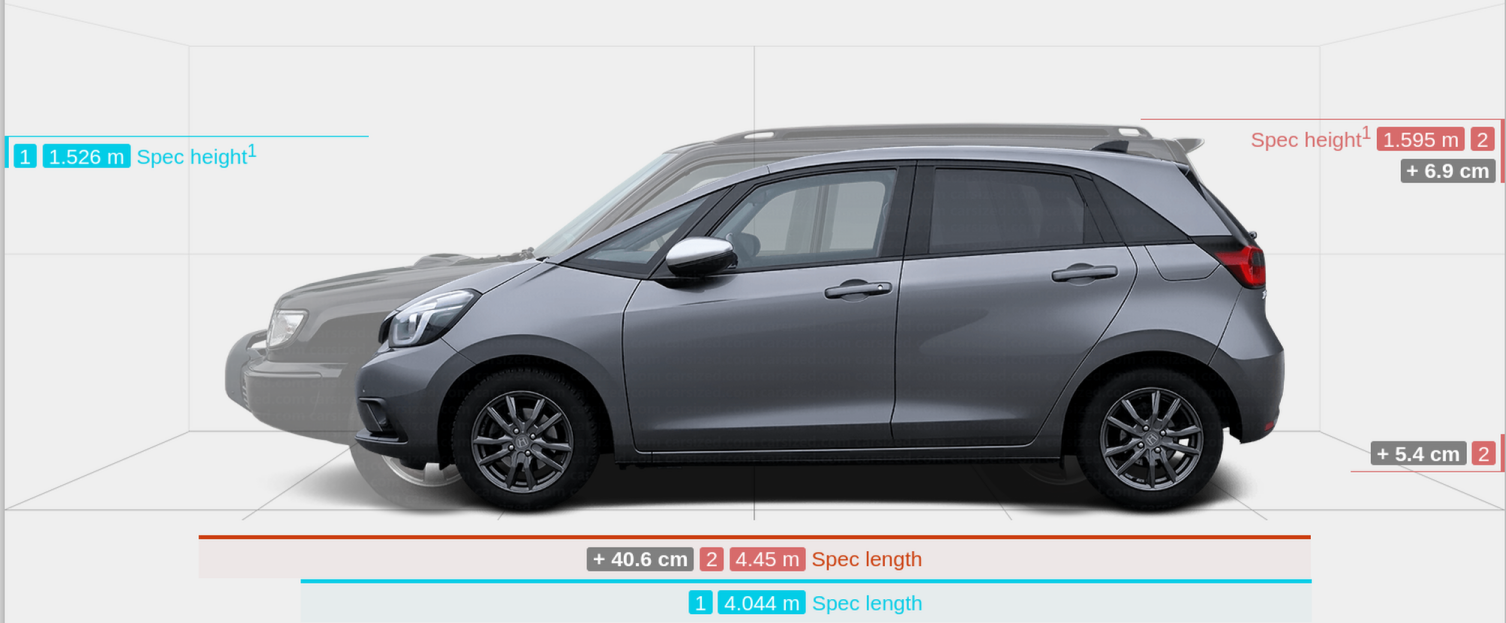
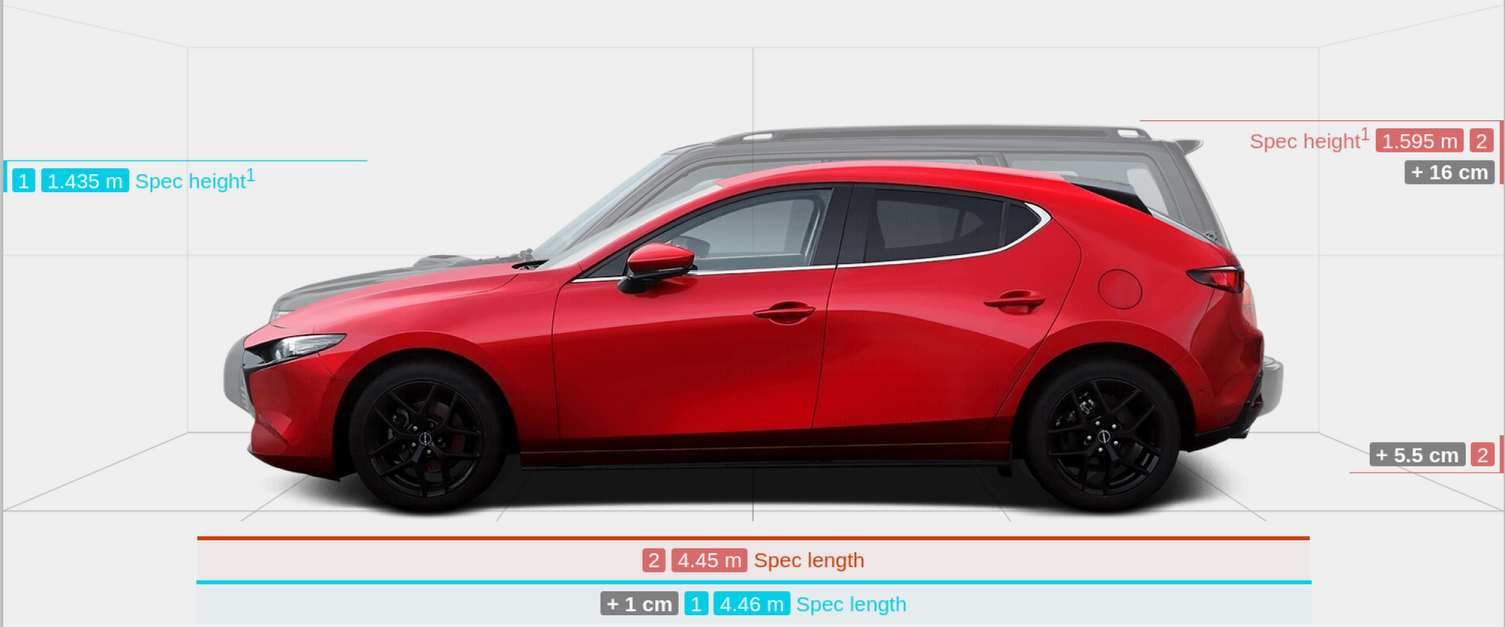
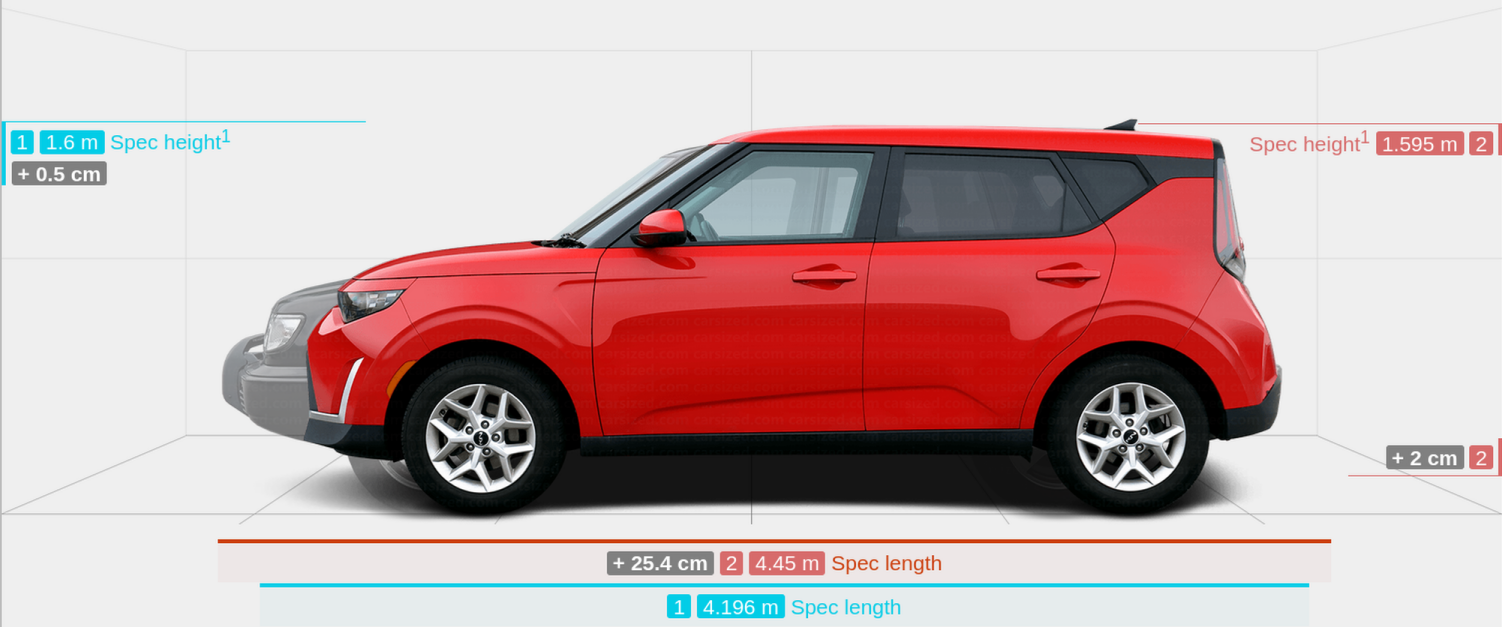
Here are some photos from carsized.com showcasing a first-gen Forester against several modern hatchbacks. The cabin sizes of these vehicles are almost identical, and there is very little height difference between the Forester, Honda Fit or Kia Soul. Only the sporty Mazda3 lacks cargo space due to its sloped roofline, but it still manages to match the Forester in length and legroom. This calls into question whether some/most/all hatchbacks are considered Crabs. According to Wikipedia and most vehicle databases, they are typically categorized as either subcompacts or crossovers. But more on that later.
A Crab doesn't need AWD or 4WD, it doesn't need a certain volume of cargo space, and it doesn't need to be boxy-looking. Put simply, a Crab is a vehicle whose primary purpose is to maximize the non-vehicular sport and utility of its users. It often compromises other attributes (such as beauty, fuel economy, and on-road handling) in favor of those. This often, but does not always, manifest in designs with tall ride height, large cabins with two or more rows of seats, hatched cargo bays or open beds, and tame, accessible driving mannerisms.
I am painfully aware of how loose the definition I've created is, but please remember the primary bit (and also remember that more constraining definitions are not implicitly more accurate).
Methodology
I purchased this rather expensive database of American market makes, models, and classes spanning from 1990-2026 to use as my primary data source. I cross-referenced it against my own knowledge, Wikipedia, and some sparse lists I was able to find online. Unfortunately, the database is pretty terrible in quality and required weeks of cleaning and validation to be usable. Issues included: misclassed or sporadically-classed models, missing production years, commas used within data cells (how do you fuck up the "comma-separated" part of "CSV"?), duplicate models, models incorrectly labeled as US market, inconsistently listing trim packages as separate models, random notes in data fields, non-UTF-8 characters, and more! Despite all that, cleaning their mess up was more efficient than learning how to scrape and validate the source data of thousands of vehicles myself.
If you get something out of this project, I'd really appreciate a tip to help cover the cost of the data. If you know me, you know I have literally never asked for this before. It's not obligatory at all. But, your support would mean a lot to me! I would also like to take a brief moment to chastise the curator for failing to include perhaps the most ostentatiously useless vehicle ever invented: the Nissan Murano CrossCabriolet. If you are not familiar with this short-lived 2000s oddity, I implore you to fix that.
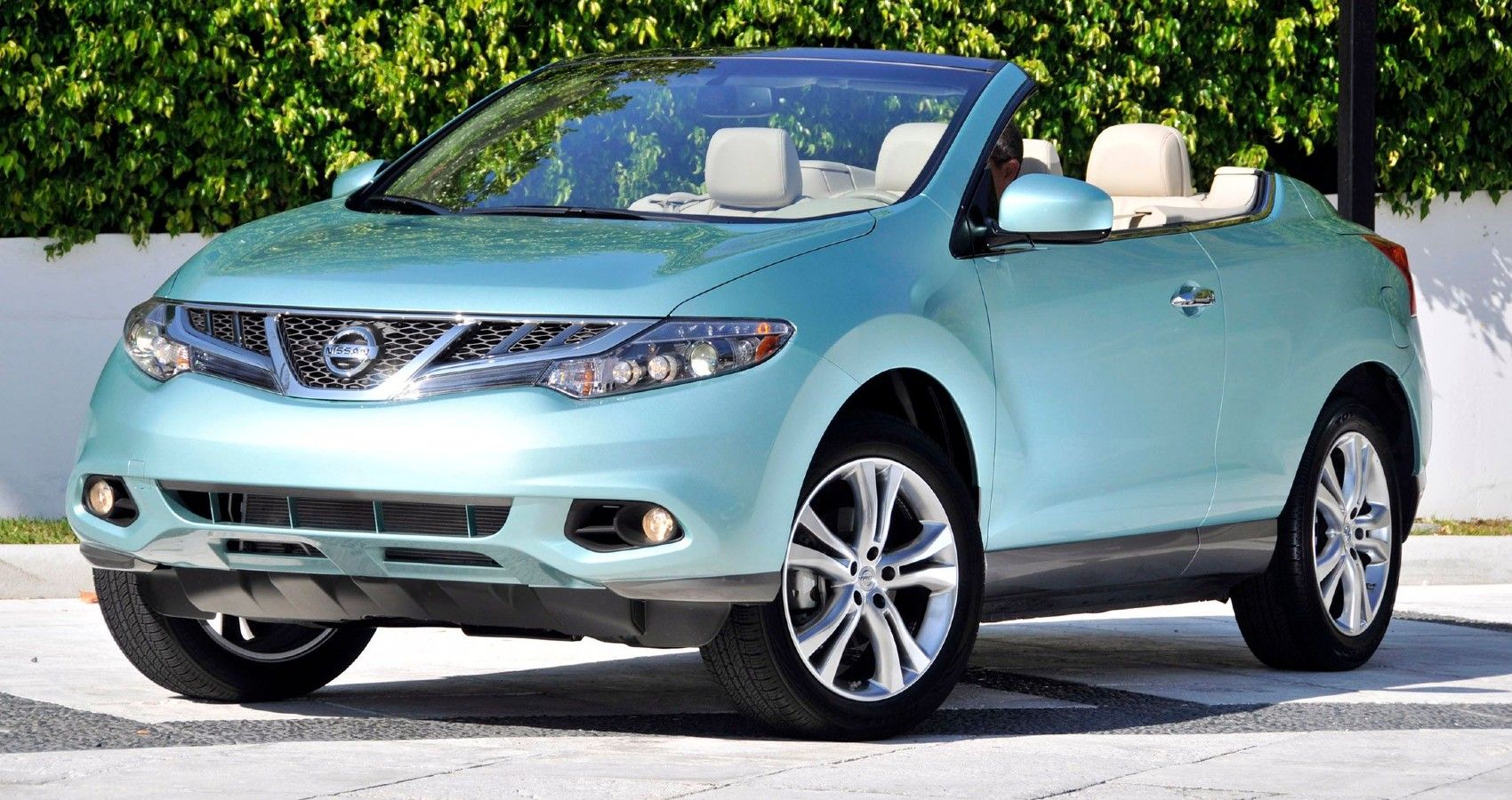
Not that it matters, because for my methodology I decided to omit all convertible variants of vehicles, treating them and their fixed-roof counterparts as one model. The core question I'm investigating with this data is: broadly, among all the vehicle models being sold in the US, how many are Crabs? And has it always been like this? This is also why I consolidate different trim levels. The Volkswagen Golf, GTI, and Golf R count as one model of car, just as the Audi Q5 and SQ5 count as one model of Crab. Vehicles with EV or hybrid variants fall under the same regard. All consumer trucks are counted as Crabs because an overwhelming majority of them have four doors and short beds, a design which exists exclusively to reduce its capabilities as a payload truck and increase passenger/internal cargo capacity. I omit all commercial/fleet vehicles such as Ford's Transit vans or Chevy's Express vans. Lastly, I omit all supercars and ultra-luxury makes and models such as Ferrari and the Ford GT. I only care about vehicles that are being purchased in significant quantities and driven by everyday people. (Though it is worth noting that the latent value proposition of Crabs is so tantalizing that even these boutique companies, known for their racing pedigree and car enthusiast lip service, now offer one or more SUV models for their wealthy clientele. After all, if you can afford one Ferrari, why not get another for the family?)
If you take issue with any of my methodology, I have great news: go fuck around with the data yourself. You can reclassify vehicles you believe are misclassed, make up new classes, and change the code that determines what classes count as Crabs. The world is your crab - I mean, oyster.
I will note that I spent several sleepless nights rearranging the data, reclassifying edge-case vehicles, and re-binning classes as Crabs or Not Crabs to see if it affected the results. The answer is not significantly - but I'll dig into that further below. The Crab classes I ultimately settled on including are:
- Compact MPV
- Compact SUV
- Compact crossover SUV
- Compact pickup truck
- Crossover
- Full-size SUV
- Full-size crossover SUV
- Full-size pickup SUV
- Full-size pickup truck
- Full-size van
- Mid-size SUV
- Mid-size crossover SUV
- Mid-size pickup truck
- Minivan
- Pickup truck
- SUV
- Subcompact SUV
- Subcompact crossover SUV
I reclassified a few individual vehicles in the database, notably the Subaru Baja which was bizarrely classed as the only instance of "coupe utility". It is a four-door lifted Subaru Outback with a bed. It is not a coupe, but it is mostly utilitarian. Therefore I binned it as a "Compact crossover SUV" to join other similarly sized and shaped Crabs, because the cold truth is that some enthusiasts' favorite vehicle is a crossover in the most literal sense of the word - and that's okay! Crabs can be cool. Wagons were reclassed from various flavors of "sedan" to their own "wagon" class, which I ultimately chose to exclude as a Crab. Circling back to aforementioned hatchbacks, I left most of them in whatever class their manufacturer and/or Wikipedia described them as; predominately they were subcompacts and therefore excluded. In my entirely subjective and therefore correct opinion, wagons and hatchbacks typically retain most of the characteristics of their driver-centric sedan counterparts (styling, driving dynamics, and low ride height) while adding some utility in the form of a hatched cargo bay. Since they are not primarily utilitarian vehicles, they are not Crabs. In all other cases, I avoided reclassification unless I considered it absolutely necessary due to being a verifiable error or outlier.
Analysis
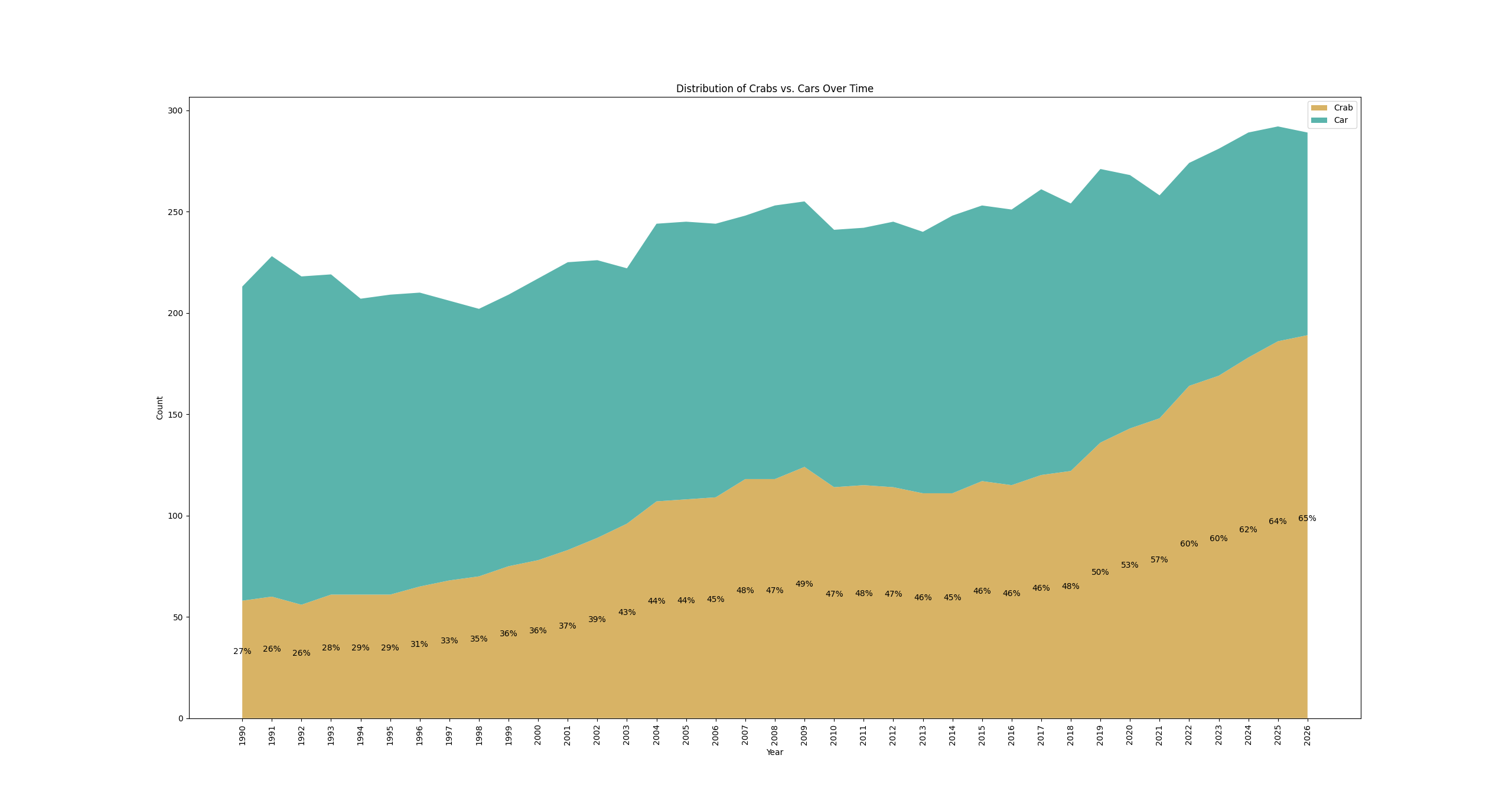
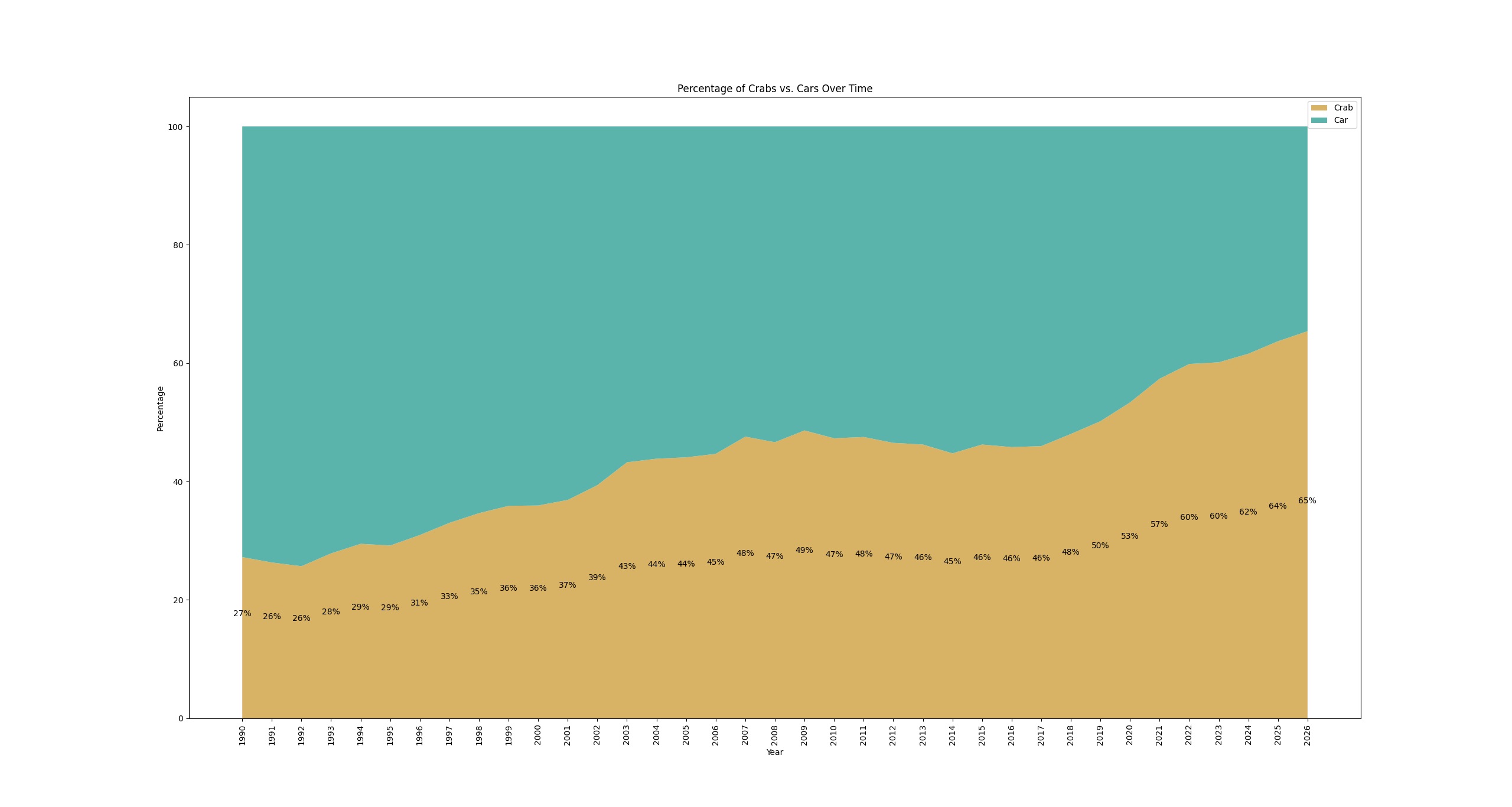
These first two graphs show a normalized and non-normalized distribution of Crabs vs. non-crabs (henceforth referred to as "cars") in each year, from 1990 to 2026. That is to say: for a given year, among every unique model of vehicle for sale in the US market, how many of them are Crabs? The non-normalized view is really only included to show that over time the diversity of models has increased considerably. Last year we saw the largest variety of models for sale ever! And yet, more of those models than ever before were Crabs. This ratio further increased by 1% to 65% this year, likely due to the retirement of several cars (such as Volvo's remaining sedan lineup) and the introduction of new Crabs (such as the BMW iX3, Genesis GV90, and Rivian R2).
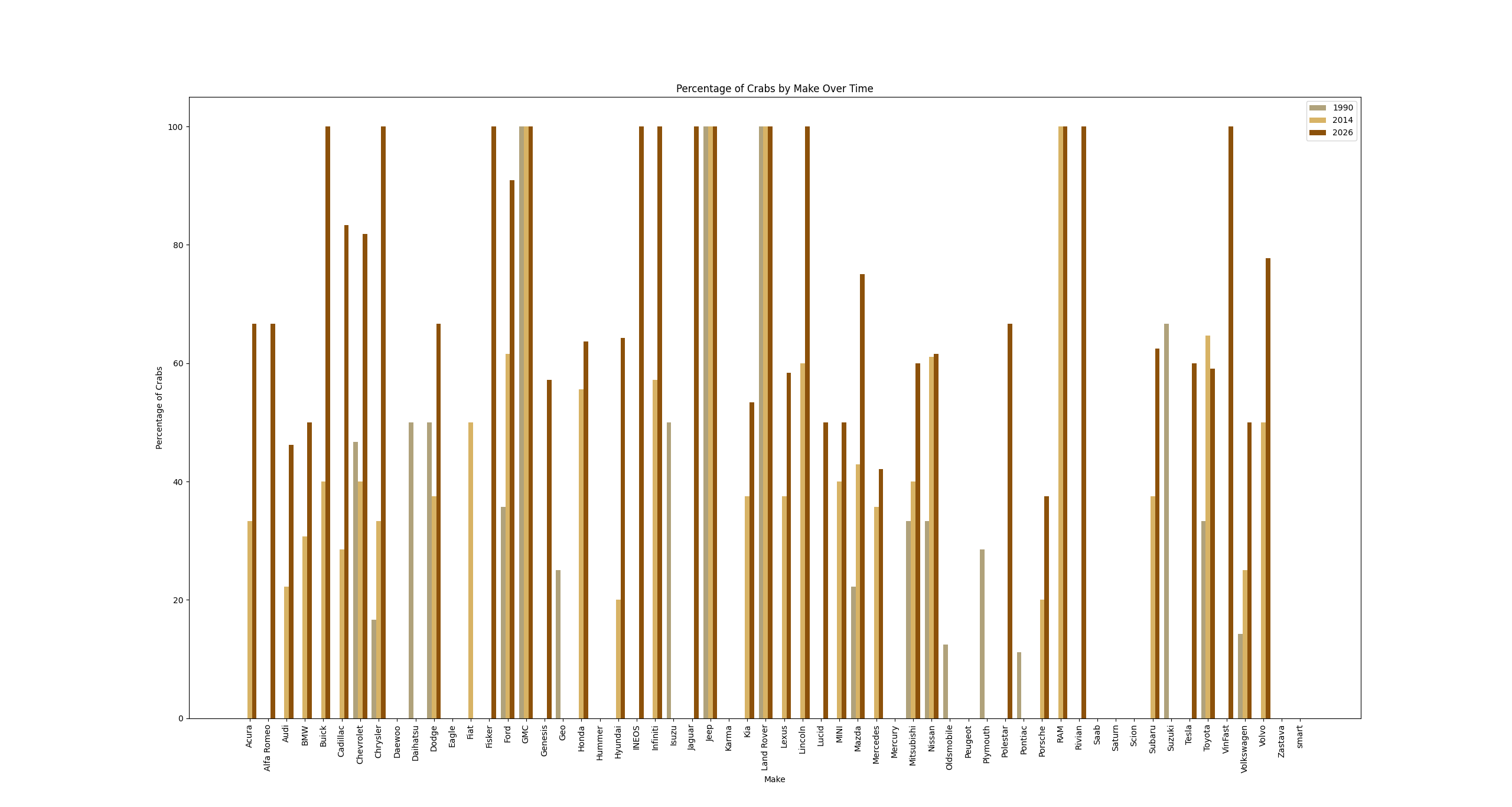
This graph provides a snapshot of three points in history (1990, 2014, and 2026), the middle one chosen specifically to act as a good midpoint without omitting Fiat's brief flirtatious period of bringing multiple models stateside. The bars represent the percentage of Crabs among all vehicle models offered by a specific make for that year. This lets us observe different makes' approaches to carcinization at a bird's eye view. I've also rendered out each individual make's carcinization chart which you can browse below. The number labels refer to the percentage of Crabs among all current models that year. If the make offered no models for sale at all in a given year, the plot is blank there.
First let's assess our home teams. American makes such as Chevrolet, Buick, Cadillac, Ford, Lincoln, and Chrysler have steadily increased the ratio of Crabs in their lineups over time, starting in the late 1990s. Major Japanese brands took notice, with Toyota, Nissan, Honda, Mazda, and Subaru all ramping up in response to stay competitive overseas. Toyota and Honda make for particularly interesting case studies because they established their American brand reputation in the 1970s and 80s on building small, affordable, reliable commuter cars. Yet in 2026 both companies offer more Crabs than cars for sale. Their younger Korean counterparts Hyundai and Kia which built the same reputation twenty years later are now also following in their footsteps. And what about our beloved Euros, once renowned for their premium executive sedans and touring wagons? BMW, Volkswagen, Audi, Porsche, Mercedes, and Volvo all tell the same tale: more Crabs, fewer cars. As expected, brands which primarily or exclusively produce Crabs such as Dodge, Jeep, GMC, and Land Rover continue along their trajectories, unwavering in commitment to the mighty crustacean form.
Before we move on, how does the carcinization rate look based on the original, unedited data? No cooking the books or reclassifying vehicles.
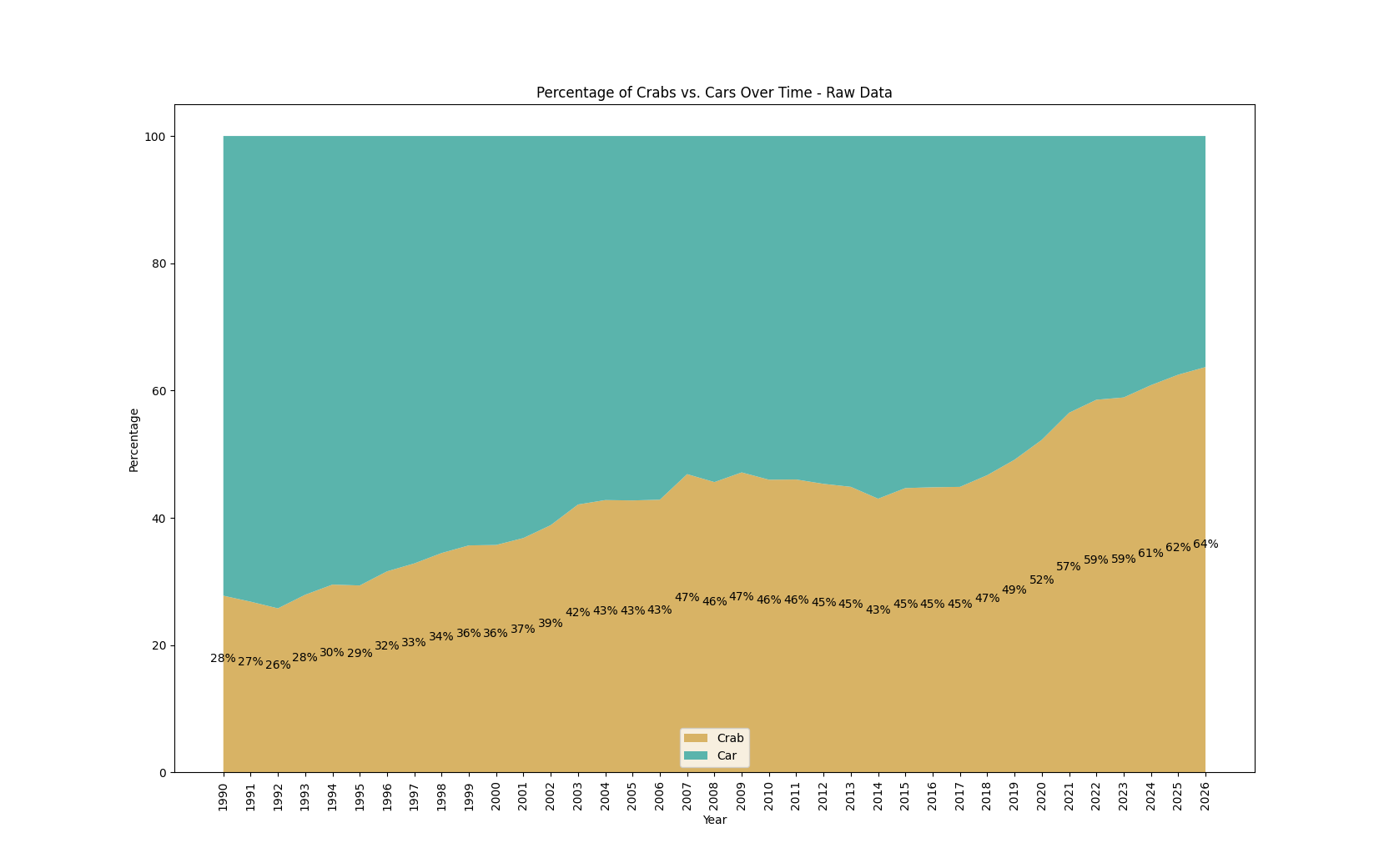
As you can see, it's almost identical. I promised the reclassification and editing I did was minimal, didn't I?
How about when we change what classes count as a Crab? Surely I'm just including trucks to inflate the numbers - people own non-fleet trucks to use them for work! They're different from Crabs! Well, first of all, no they don't. This survey conducted by vehicle owner research firm Strategic Vision reveals that 40% of truck owners drive their vehicle purely for pleasure at least once a week, and an overwhelming 90% never use them professionally. This survey was segmented based on truck subclasses (EV, standard, full-size, and heavy-duty), revealing thankfully that larger trucks tend to be used as trucks more often. But it's abundantly clear from the data why all modern trucks have 4WD or AWD, spacious four-door cabins, and tiny beds: people love to use them as Crabs. In a CBS News interview, Ford CEO Jim Farley perched himself on the tailgate of a high-trim, crew cab F-250 Super Duty in a fitted suit jacket, hay bale underfoot, horse racetrack in the background, and said, "F-Series is the second most valuable consumer product by revenue behind the iPhone[...]This is the modern horse. You can do work on, you can have fun with, you can kind of go anywhere. It's an American lifestyle." Seriously. You cannot write satire better than reality. But for argument's sake, let's see how the carcinization chart looks without any trucks:
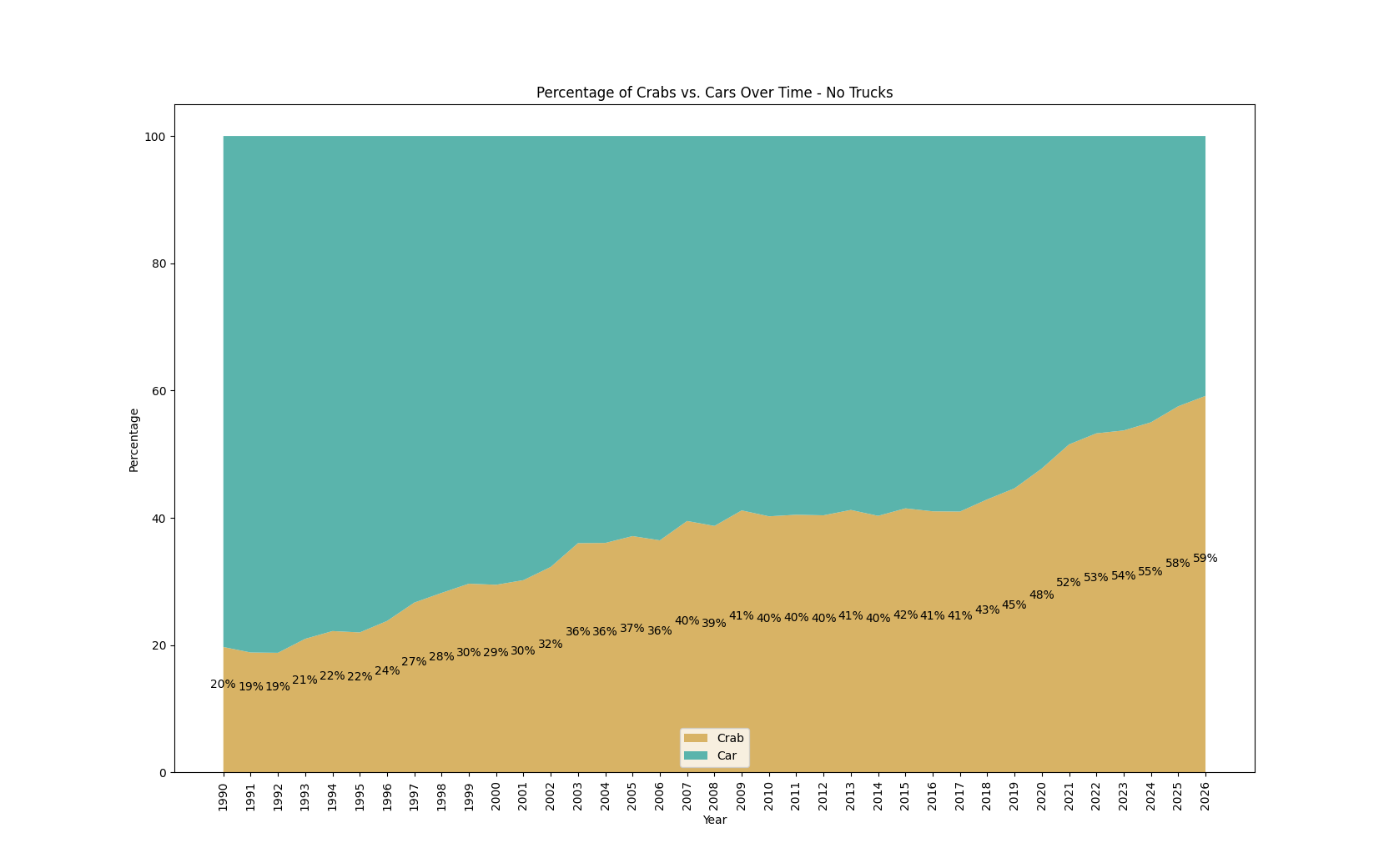
Compared to my original analysis, these results still tell the same story. Although the Crab ratio drops, it does so almost perfectly linearly - 6-8% in each year. The 50/50 threshold is passed in 2021 instead of 2020 - barely a difference. And by 2026, there is still a significant majority (59%) of Crabs for sale vs. cars and trucks. This provides some additional evidence of why the overall Crab ratio has increased over time despite the increasing diversity of models: most brands, regardless of their historical specialization, nationality, core audience, or size, have shifted their strategies in the twenty first century to include more and more Crabs. That's a pretty overwhelming answer in favor of the Crab as the most successful vehicle species from a proliferation standpoint. And to check in with the introduction, here are all the model names which mutated into Crabs over time:
- Ford Mustang (Mach E)
- Ford Maverick
- Jaguar E (Pace)
- Dodge Hornet
- Mitsubishi Eclipse (Cross)
- Toyota Corolla (Cross)
- Chevrolet Bolt (EUV)
As a brief aside which will become relevant soon after, here is the full list of vehicles that changed classes over the years:
- Buick LaCrosse (mid-size car -> full-size car)
- Chevrolet Trax (subcompact crossover SUV -> compact crossover SUV)
- Chevrolet Trailblazer (mid-size SUV -> compact crossover SUV)
- The bastardized nomenclature of the Chevrolet Blazer deserves an entire paragraph unto its own...so here it is. It began as a two-door 4x4 SUV known as the K5 Blazer in 1969, built on the C/K truck platform to compete against the Jeep and other offroad vehicles. Fourteen years later in 1983, they built a smaller SUV on the S-10 truck platform and confusingly named it the Blazer. (Although the K5 Blazer always received badges denoting its roots, the S-10 Blazer was only ever branded as "Blazer". Wikipedia claims the S-10 Blazer had an "S" badge, however I have never seen one in person nor can I find one among the litany of online S-10 Blazer photos, so citation needed.) The larger K5 Blazer's four-door variant eventually donned the beloved Tahoe nameplate in 1995 while the S-10 Blazer continued soldiering on as the Blazer until 2005. However, this meant that from 1992-1994 the Chevy Blazer was simultaneously a full-size and mid-size SUV. The Blazer name was later revived in 2019 for a new, unibody platform mid-size crossover SUV which remains in production currently. Then there is the related-yet-unrelated TrailBlazer, which originally started as a luxury trim package for the four-door variant of the 1999 model year S-10 Blazer only to be spun off as its own uniquely-styled mid-size SUV from 2001-2008, then later revived in 2020 as a small crossover SUV. So the Blazer's evolution is: mid-size SUV (original K5 two-door) -> mid-size SUV/full-size SUV (S-10/K5) -> mid-size SUV (1995 Blazer) -> mid-size crossover SUV (2019 Blazer). If anyone working at Chevrolet is reading this, I only have one thing left to say:

- Chevrolet Trax (subcompact crossover SUV -> compact crossover SUV)
- Chrysler Pacifica (full-size crossover SUV -> minivan)
- Dodge Avenger (sports car -> mid-size car)
- Dodge Durango (mid-size SUV -> mid-size crossover SUV)
- Ford Taurus (mid-size car -> full-size car)
- Ford Ranger (compact pickup truck -> mid-size pickup truck)
- Honda Insight (subcompact car -> compact car)
- Honda Civic (subcompact car -> compact car)
- Honda Accord (compact car -> mid-size car)
- Honda Passport (mid-size SUV -> mid-size crossover SUV)
- Jeep Wagoneer (full-size SUV -> compact SUV -> mid-size SUV -> full-size SUV)
- Jeep Grand Cherokee (mid-size SUV -> mid-size crossover SUV)
- Lincoln Aviator (mid-size SUV -> full-size crossover SUV)
- Mazda Protege (subcompact car -> compact car)
- Mazda 626 (compact car -> mid-size car)
- Mercury Cougar (sports car -> compact sports car)
- Mitsubishi Mirage (compact car -> subcompact car)
- Nissan Pathfinder (mid-size SUV -> mid-size crossover SUV)
- Scion xB (subcompact car -> compact car)
- Subaru Outback (wagon -> mid-size crossover SUV)
- Toyota Camry (compact car -> mid-size car)
- Toyota RAV4 (subcompact crossover SUV -> compact crossover SUV)
- Toyota 4Runner (compact SUV -> mid-size SUV)
- Volkswagen Golf (subcompact car -> compact car)
- Volkswagen Jetta (subcompact car -> compact car)
Editor's note: If you run the function that generates this list yourself, you'll notice it differs slightly from the list here. That's because for each model, I manually validated its historical classifications and general attributes (size, chassis, style) and only included those which physically changed in a significant way. Data is messy. Trust but verify.
This seems to prove the popular belief that models get bigger over time as they are refreshed for new generations. Seventeen models from this list grew in size classification over time, whereas only three models shrank. Six models changed classes without changing size, primarily SUVs which transformed into crossovers in later generations to exchange offroad capability for ride comfort (based on Wikipedia's definition of crossovers as "SUV-styled vehicles with unibody construction", paraphrased). Anyway, back to the Crabs.
We've now proven definitively that carcinization is no fluke. Crabs are more prevalent than ever before, and there are more varieties of them every year. But we haven't figured out why.
How Did We Get Here
Unlike a natural environment where species variation occurs randomly and persists due to lucky advantage, vehicles are curated and tailored by manufacturers to appeal to known, measurable consumer needs and wants. Thus, there are myriad potential incentives for carcinization in the auto industry. Let's start with a consumer hypothesis.
Have you ever heard someone come back from a dealership and say, "Well, I could've gotten a smaller car, but this larger one was such a great value!"? Anecdotally, I have countless times. Brands know this and upsize vehicles over time intentionally to make consumers think they're getting "more value" by upgrading, as proven by the earlier aside. But how much truth is there to the theory that bigger vehicles are a better deal? We need to account for upsizing in our analysis; it would be inaccurate to compare an old Toyota Camry to a new one. Instead, we need to find a modern model that offers comparable features in a comparable footprint. For cars, the current equivalent of a 1990 Toyota Camry would actually be its little sibling Corolla. Don't believe me? Here, take a look. In 1990, a new Camry cost $11,600, whereas a 2024 Corolla's MSRP was $23,200. As for Crabs, let's use Toyota's 4Runner and Corolla Cross as our nearest size neighbors. The 1990 4Runner cost $16,200, while the 2024 Corolla Cross cost $25,200. That's a price difference of $11,600 for the cars and only $9,000 for the Crabs.
How about a domestic example? The 1990 Chevy Suburban cost $16,200 new, while a 2024 Tahoe was an eye-watering $58,200. A 1990 Caprice was $14,500 and a 2024 Malibu was $26,200. With respective differences of $42,000 and $11,700, it seems the only conclusion that can be drawn here is that Chevrolet decided to pump the margins on their Crabs...let's pivot to the blue oval:
- 1990 Ford Taurus: $13,000
- 2020 Ford Fusion (Ford stopped making cars, this is the closest I could get): $24,000
- 1991 Ford Explorer: $21,600
- 2024 Ford Bronco Sport: $30,600
Here we see similar results to Toyota, with the car price changing by $11,000 and the Crab price changing by $9,000.
Jumping over to Europe, the only brand offering Crabs for sale in the US back in 1990 was Land Rover. Unfortunately they don't make cars:
- 1990 Discovery: $28,900
- 2024 Discovery (shockingly, a model name that didn't significantly change size in thirty years): $61,500
- Difference: $32,600
I don't have the spoons in me to do this for every brand in the database, but thankfully there isn't enough correlation to justify that. It seems the value-driven argument is pretty spineless. The pricing of Crabs hasn't improved compared to the pricing of cars; if anything, it's completely random. That being said, we can look at longitudinal sales trends (since what people actually buy sometimes differs from MSRP) to explore the deeper financial value of Crabs.
Kelly Blue Book (a subsidiary of Cox Automotive) published these findings citing both MSRPs and actual sales prices on the incline with an average of over $50,000. But the most interesting observation was this:
"Popular full-size pickup trucks continue to pull the industry average higher. The average MSRP in January for a full-size pickup was above $70,000 for the fifth consecutive month; despite sky-high prices, more than 150,000 were sold. For comparison, the subcompact car segment, where the average MSRP was less than $26,000 in January, fails to attract buyers. Less than 4,000 subcompact cars were sold last month."
KBB's executive analyst Erin Keating had this to say:
"Consumers are still finding plenty of options below the industry average, especially in core segments like best-selling compact SUVs, but the disappearance of true entry-level vehicles continues to lift the floor higher. At the same time, strong sales of full-size pickups and large, luxury SUVs keep pulling the averages up, proving that demand for high-priced models remains incredibly resilient."
This fantastic research article (seriously, go read it) by Matt Hardigree adds another angle. His findings indicate that not only are Crabs more profitable for automakers compared to cars, but also that companies intentionally reduced the supply of base trims available during the COVID-19 pandemic (and afterwards) to keep margins up during a time of lower demand. Aside from proving the long-assumed truth that manufacturers make most of their profit from trim packages, this also indicates that it's in automakers' best financial interest to sell as many mid and high-trim Crabs as possible (as opposed to other vehicle types and base trims). The Cox Automotive data doesn't talk about manufacturer supply, only pricing. But holding these trends next to each other, I wonder if the lack of sales in the subcompact market is not only driven by a lack of demand, but also by a lack of supply. Are there simply fewer cars being made because Crabs are more profitable? If a company profits more off a Crab than a car, why would they try to sell cars? Anecdotally, most dealerships in my area are stocked to the gills with Crabs. Cars are usually relegated to a side lot or scattered among their taller siblings. Unfortunately it is near-impossible to get real manufacturing quantity data. Maybe the folks over at CarEdge could come up with approximates using their dealership data, but I'm not a journalist and can't pay them to run those numbers.
Regardless, the "more car for your dollar" theory is dead. People who think they get "good deals" on larger vehicles are just being swindled by salespeople. But along the way we've proven a new theory: carcinization is incentivized by automakers' profit-maximizing behavior. Brands have no reason to produce vehicles classes that have lower profit margins, and their shift in offerings over time reflect that. The higher margin on Crabs only has room to increase with the growth of EVs. Manufacturers are shifting to skateboard) designs which enable them to use the same chassis across multiple vehicles, even scaling easily to accommodate different sizes. This substantially reduces production costs compared to traditional methods.
What about a different consumer angle: how much vehicle can people actually afford? Crabs are typically more expensive than cars, after all. We need to see whether or not Crabs are financially attractive to typical households, as well as how popular they are by sales figures.
Looking at the US census historical income tables, we can use the median household income from 1983 to do some forward projections of the new vehicle base CPI. We also need a reference vehicle - let's use the 1983 Honda Accord. Although its base price was $8,550, it would be more accurate to use the mid-trim price of $10,300 "for the LX automatic four-door sedan", since that accounts for some of the optional features that are considered standard equipment today. While certainly not the cheapest vehicle on the market at the time, the Accord is a great "average" pick due to being an affordable, reliable, multi-purpose car of its era. 1983's median household income was $20,890.
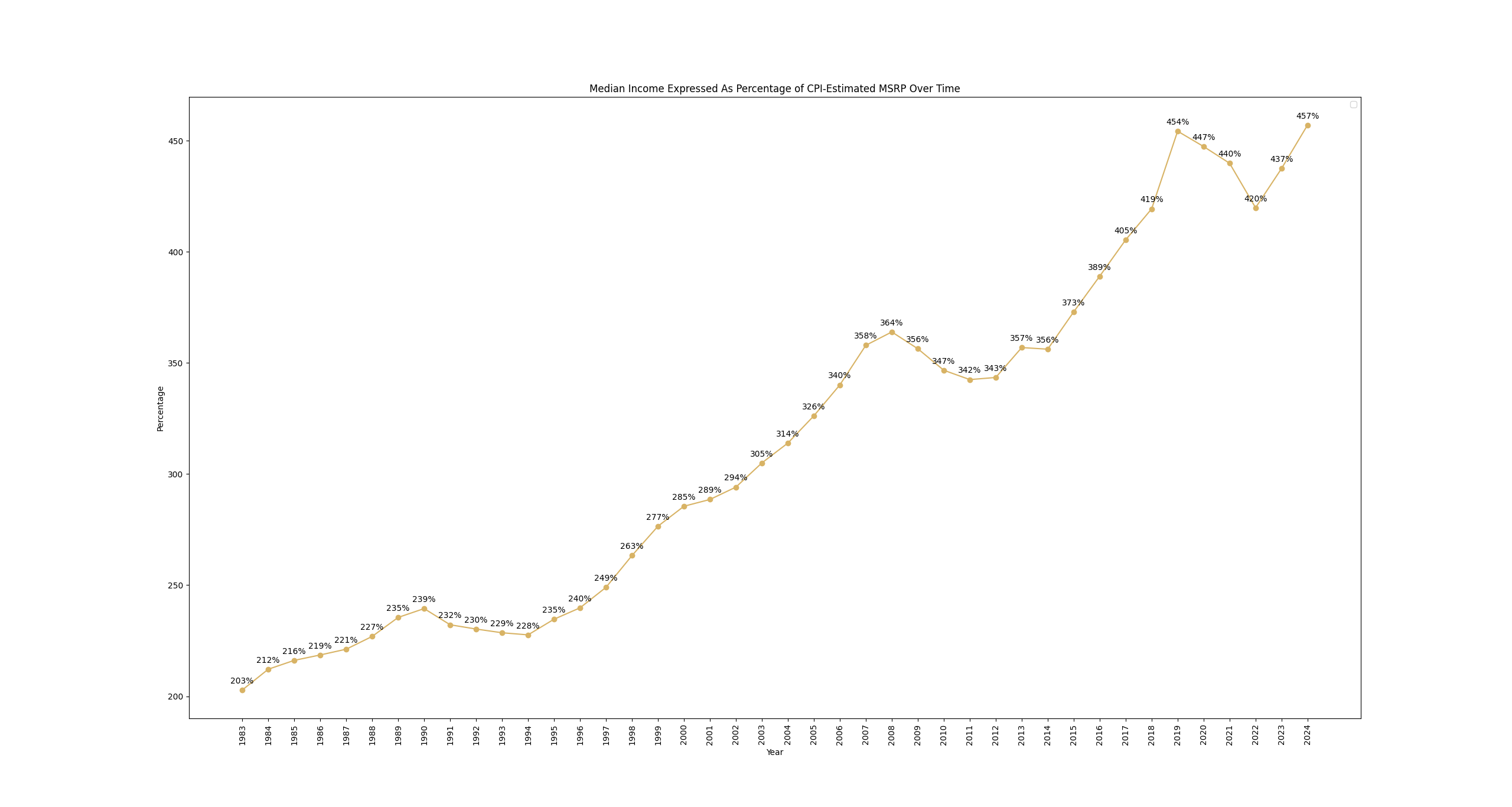
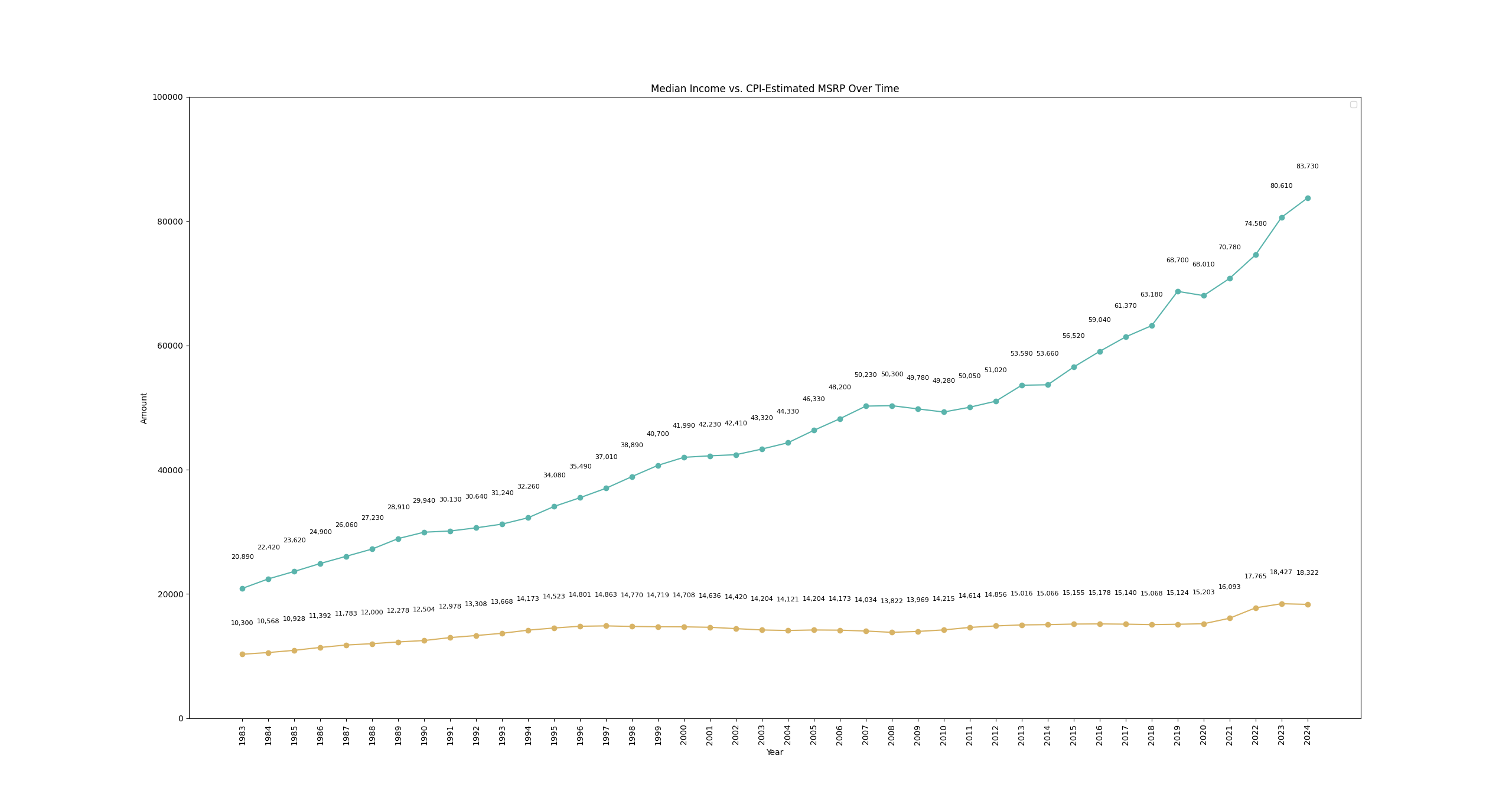
The top graph depicts the ratio of median household income to a theoretical "typical" MSRP (projected using the BLS vehicle CPI data from 1983-2024), with our $10,300 1983 Honda Accord as a seed. The picture it paints is very optimistic! Consumer buying power has more than doubled in the last forty years, at least relative to vehicles. The graph below it shows the individual plots of median income and estimated vehicle MSRP so you can see the exact values. By 2024, our "typical" vehicle has an MSRP of $18,300 and our median income is more than quadruple that at $83,730. However, if we try to find a modern vehicle with a matching budget, the only vehicle cheap enough would be a Nissan Versa sedan. Its 2024 MSRP was $17,800. There's only one problem: as you may suspect, the Nissan Versa is not a typical car. So what gives?
CPI tells a one-note story about pricing. It struggles to compare products from different time periods fairly because in reality, technology advances and expectations change. Vehicles today can't be optioned with power steering, ABS, traction control, airbags, backup cameras, infotainment systems, and air conditioning; for better or worse, those are all standard issue. They are more powerful, more spacious, more comfortable, and safer than ever before. But all these features add cost. Even Car & Driver glumly notes in their cited review that "the 2024 Nissan Versa is the last bastion of cheap transportation", an outlier living past its time in the modern vehicle marketplace. If I had to make an uneducated guess, I'd bet that the base model Versa is a loss leader product that very few people buy. C&D notes that in base trim it lacks common features such as Android Auto/Apple Carplay infotainment, remote start, and "a center console with an armrest" (wow). Adding those features in by jumping to a higher trim level also jumps its price by four thousand into the same territory as the better-equipped and more reliable Honda Civic and Toyota Corolla. So, to recap: in 1983, $10,300 could buy a Honda Accord - a vehicle whose fit/finish, handling, and features were lauded by Motorweek as the gold standard. They considered it a premium-feeling and premium-priced commuter car of its time. If you were to spend comparable money on a similar car today, you'd end up in a vehicle C&D described as "...likely too spartan for all but the most miserly buyer". But remember that a 1983 Accord would be called the same today, if not worse! It doesn't even have power windows or mirrors. The standards of what is acceptable for a vehicle, let alone the standards of what is considered premium, have changed dramatically in forty years.
Those rising standards combined with the CPI data above lend plausibility to the theory that people can afford much more vehicle today than in the 80s. I spoke to a finance professor and read her personal finance textbook's chapter on vehicle purchasing to get some harder numbers. Our median household's take-home pay is about $69,700 after taxes. If they practice good budgeting behavior, they should allocate no more than 10% of that monthly take-home on a vehicle payment. Assuming a loan term of 48-60 months, an interest rate of 5-7%, and a down payment of $2,000, they can afford a vehicle that costs up to a range of $27,200-$31,300. That's substantially above the CPI-estimated MSRP of $18,300! They're comfortably positioned to enjoy a brand new mid-trim small vehicle or base-trim midsize vehicle. If they prefer buying used, CARFAX indicates they can buy any class of vehicle they desire for $30,000 or less, with trucks, luxury SUVs, and luxury cars only two to four thousand above that cut. They have no need to settle for a base trim Sentra in today's market (even if it would be a much thriftier decision)...
...Except that's not what people are doing. As cited earlier, the average transaction price has crossed $50,000 and that figure is largely inflated by trucks. This Forbes article reveals just how popular this subspecies of Crab is - they are the leader of vehicle ownership by class! Trucks account for "[...]170,239,357 private and commercial vehicle registrations in 2022, compared to 98,573,935 vehicle registrations for cars". (And yes, that includes fleet trucks, but it also includes fleet cars like rentals and taxis.) That's a whopping 72% more trucks than cars. LendingTree updated its auto debt statistics for 2026, showing a continuing and alarming trend of rising average new car payments. It is now $767/month, far above the $581/month spending limit of our median household. Obviously, average != median. There are numerous households than can afford more and spend more, and the average used car payment is within bounds at $537. But that's still pretty close to the limit, and between raw sale quantities, pricing data, and year-over-year lengthening repayment schedules, it's pretty safe to conclude that Americans aren't just buying what they can afford - they're buying much more. As one final nail in the coffin, here is Cox Automotive's raw data table for January 2026 average transaction prices, sorted by manufacturer and vehicle class:
To recap, here are our consumer-related findings:
- Crabs are financially within easy reach of the median household.
- Trucks are by far the most popular vehicle class.
- New vehicle payments are way above what most people can afford.
The verdict: American consumers are in love with Crabs. This isn't a one-sided relationship of brands cramming Crabs down everyone's throats for the sake of increasing profit - this is willing, widespread endorsement of larger, more expensive vehicles. Both sides want this.
Is this habit unsustainable? Well, maybe. I'm not an economist and it's not my place to make market projections. My carcinization plots show it's been sustainable for thirty years, with only a brief pause in the 2010s following the Great Recession. But that was a pause, not a reversal of course. In hard times, people continued driving what they already owned and brands waited on altering their lineups. When gas prices went up, nobody bought a smaller vehicle to save pennies at the pump - the required increase in gas cost to offset a vehicle purchase is nigh-impossible. Today, if gas becomes so expensive that it significantly impacts someone's travel expenses, there are a plethora of electric and hybrid vehicles for them to choose from - predominantly Crabs, of course. After all, the fifth best-selling vehicle of 2023 was the Tesla Model Y. That being said, even though vehicles are more affordable than ever, they are also more expensive than ever.
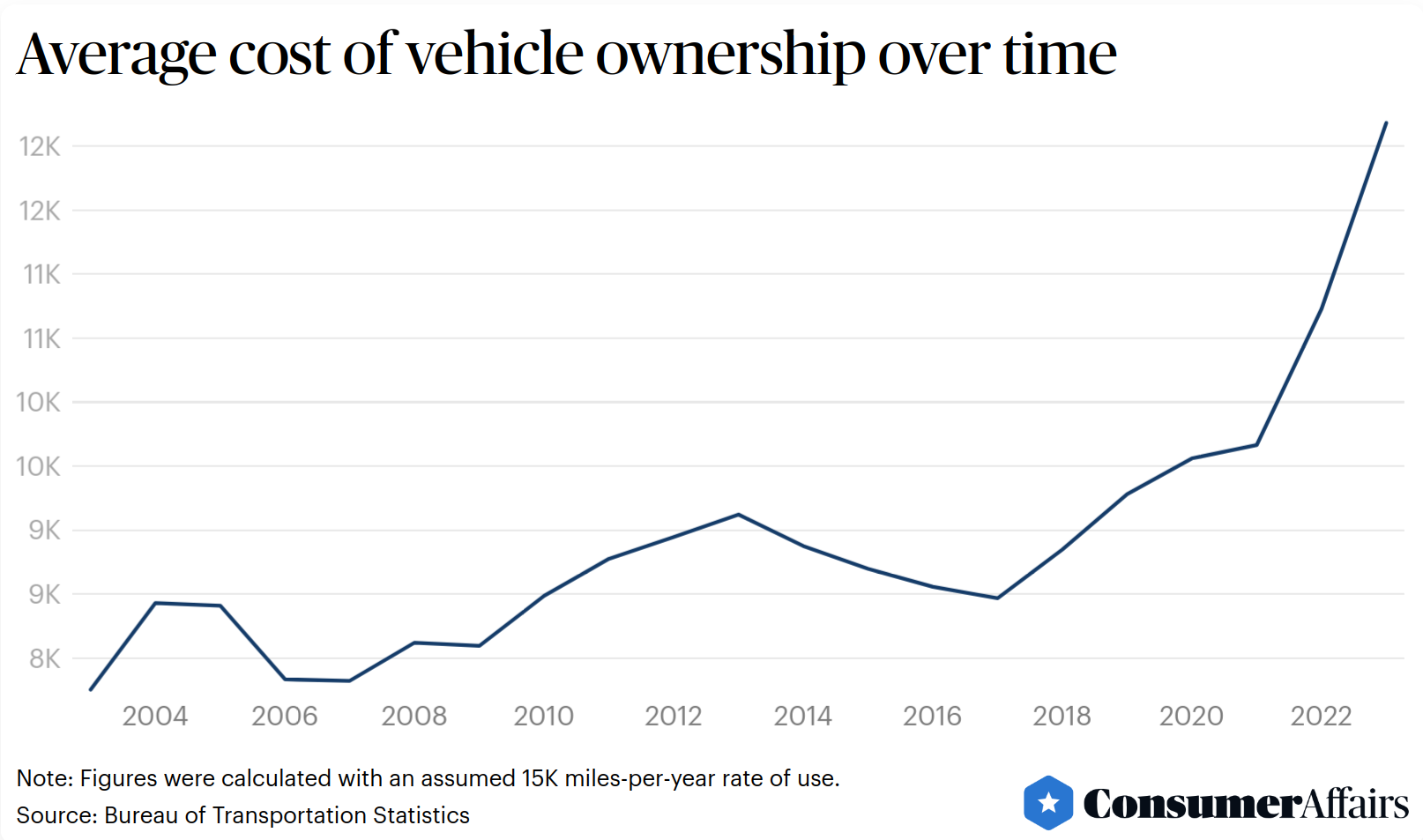
We are quickly approaching an era where vehicles are so large and feature-laden that brands don't offer any below $25,000. Soon they'll be scraping against the spending limit of our median household, meaning most people will be priced out of new vehicles and fully reliant on the used market (for better and worse). Based on purchasing trends, does this mean our used market of the near future will be predominantly mid-trim four-door trucks and luxury crossovers? If most consumers get priced out of a Crab-dominated new vehicle market, will manufacturers change tune and start building cars again? After all this hemming and hawing over data tables, the only certain reasons for carcinization I can find are Crabs' profitability for manufacturers and their pleasure for consumers. If those benefits continue to hold, there is no reason for vehicle evolution to change course.
Epilogue
If you've made it this far, kindly indulge me for one final chapter which is more journalistic and less data-driven. Now that we've discovered why Crabs are so prevalent, I'd like to provide an honest opinion as to why they're so popular.
Early Brass Era motor carriages were largely inspired by horse-drawn carriages. Plush bench seats, tall ride height, wagon wheels and leaf spring suspension all combined into a package comfortable (enough) on the terrain of the early 1900s, be it asphalt, cobblestone, or dirt. They were vehicles intended to get around in all situations except extreme ones. Some were smaller affairs intended for "motoring", but the majority were either two-seat commuter cars or family haulers with room for baggage and kids. Even the commuting-oriented models looked remarkably Crab-like. Vehicles of the 1920s and 1930s followed this trend, optimizing their suspension for tarmac while maintaining a tall ride and carriage body style. They're large, imposing, impressive creatures. Even at rest, they look poised to carry you effortlessly.
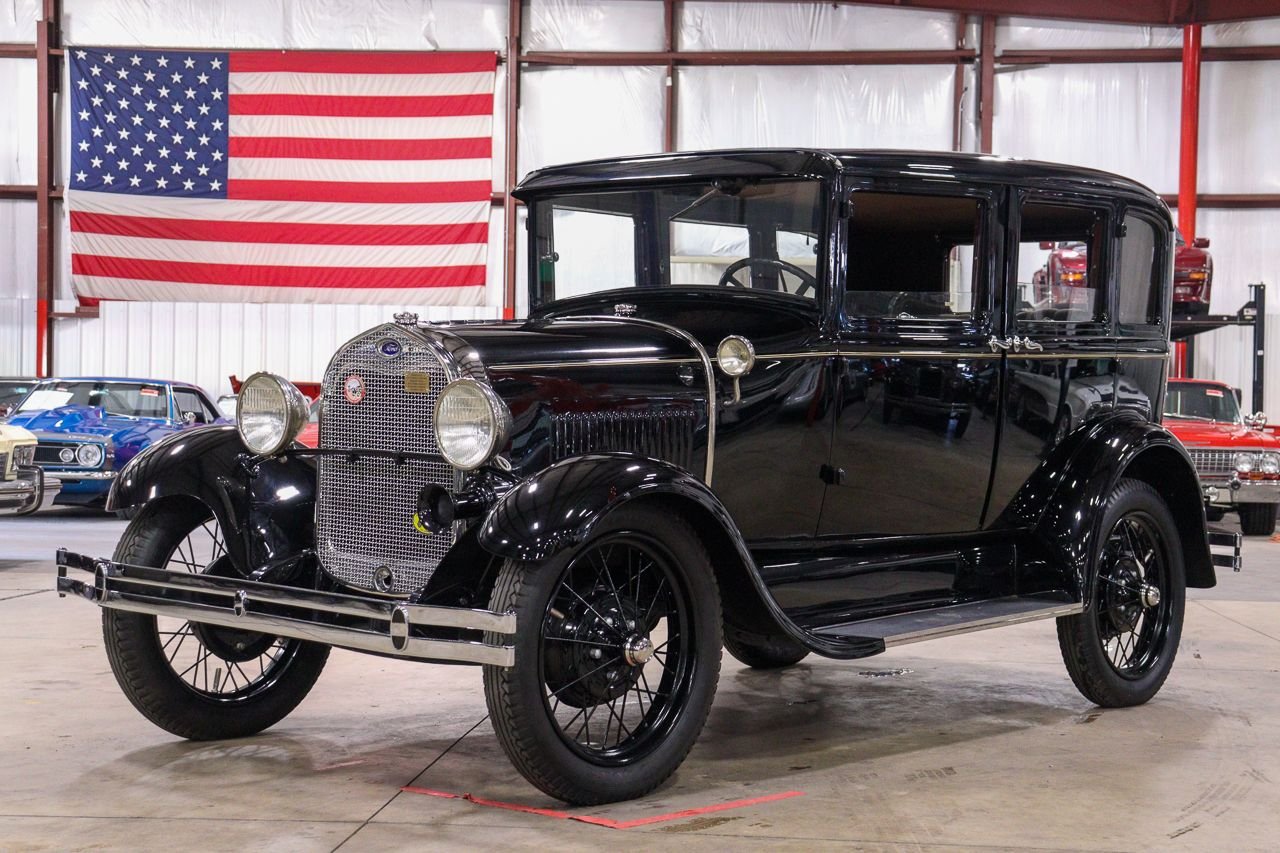
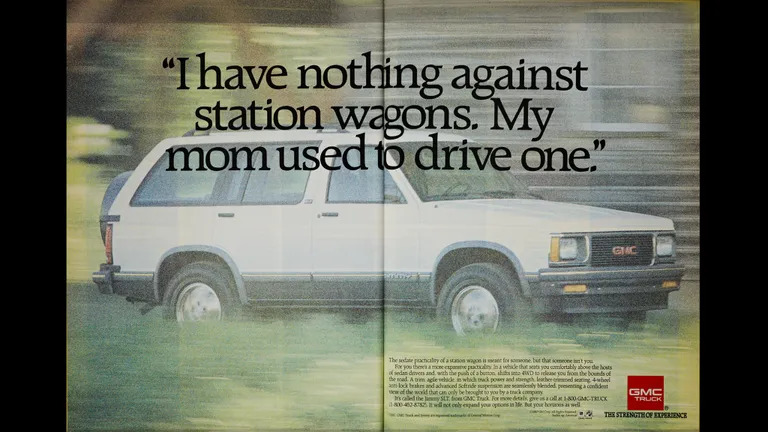
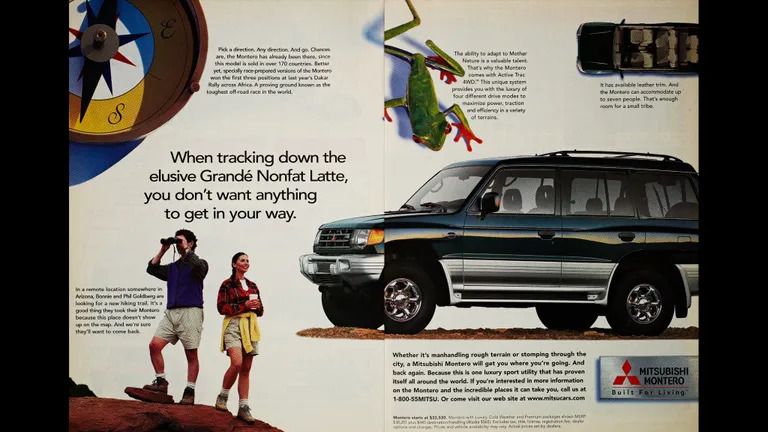
The social reasons for this design's success are much the same as Crabs today. Brands marketed them with appeals to freedom of mobility, convenience, comfort, and human utility. Just look at this 1920s promotional film by General Motors, advertising and catering each of their brands to a segment of the burgeoning vehicle market. Go anywhere! Do anything! Enjoy the luxuries of modernity! Now take a gander at these 1990s paper ads. While the car ads emphasize performance, styling, and affordability, the Crab ads push lifestyles of comfort, convenience, and adventure. Two of them are especially noteworthy:
- GMC Jimmy (1992) fires a point-blank shot at the declining reputation of "mom-mobile" wagons to position the SUV as the cool alternative.
- Mitsubishi Montero (1998) directly calls out Americans' growing habit of buying Crabs and never taking them off-pavement, yet reassures in the subtitle,"Whether it's manhandling rough terrain or stomping through the city, a Mitsubishi Montero will get you where you're going."
What are Crabs but a heartfelt centennial embrace of the motor carriage? The perfect vehicle for the typical consumer who is unsure of their needs and social standing. Fueled by the maybes of life, the Crab soothes anxieties about the future. What if I have a kid? What if I get really into hiking? What if I need to drive in the snow? What if I need to haul a bunch of shit? What if I need to take my family on a roadtrip? Buy a Crab, and you won't need to worry about any of that. Hell, you won't even need to think of questions to ask - the Crab will have an answer when the time comes. Sure, there are other vehicles that are better at certain jobs, but none of them are adequate at every job. And before you criticize people for buying vehicles without considering their realistic needs, remember that we are all typical consumers about something. Maybe it's your smartphone. Maybe it's your clothes. Maybe it's your cutlery, your TV, your tools, your earbuds, your keyboard, your furniture. There are too many products in the world and too many needs in your life for you to think critically about every purchasing decision. Most purchases are made to solve a nebulous problem in the fastest and easiest way possible. You are not different. I am not different. Consumerism is built on the foundation of peace of mind, otherwise known as convenience. And the Crab is the pinnacle of automotive convenience.
My vehicle ownership is very atypical from the modern norm. I recently moved from a hatchback to a two vehicle solution in the form of a two-door base-trim truck and a twenty-five year old sports car. The truck sits around unless I need it for truck duties and the sports car is driven daily as long as it's not snowing. I'm able to invest time into repairing my own vehicles, which helps me afford two of them. I also have a loving husband who lets me borrow his Crab whenever I need its all-weather, all-road, or four-door capabilities (or when the sports car is broken). These unique circumstances enable me to live every car enthusiast's dream of owning specialized vehicles - one great at hauling, one great at driving, neither useful for anything else. Every drive is engaging in a unique way. I can fully embrace the truck experience of commanding a large vessel or the sports car experience of darting between traffic.
And yet, I still miss my hatchback. Carrying passengers or personal cargo, driving off-road or in deep snow, and riding comfortably are all harder now. Most households can't and/or won't make the necessary lifestyle changes for daily-driving a sports car, two-door truck, or even sedan. There's an argument to be made for hatchbacks and wagons, but we collectively decided they were uncool twenty years ago. (Most enthusiasts would bin all but the sportiest among them as Crabs anyway. The only reason we think hatchbacks and wagons are cool now is because they lost popularity. You can't change my mind, and you know I'm right.) This problem is amplified by the fact that the vast majority of households only own one or two vehicles, with only 22.1% of households owning three or more like mine. If you can have two vehicles in your household, then maybe you can get away with one specialized vehicle and one Crab. But what if you can only have one? Intentionally buying a less convenient vehicle would be a rejection of consumerism - an acknowledgement of introducing potential stress into your life.
At the heart of all of this, maybe that's the real reason enthusiasts hate Crabs. We're a countercultural bunch, after all. To reject the Crab is to embrace challenge! Bring it on, come what may! We're brave and willing to sacrifice convenience to make the act of driving engaging and enjoyable once more. Or maybe it just soothes us to punch down at others who don't view driving the way we do. Others who are just as stressed as we are about making it through life in the American Century Of Humiliation. Others who will do anything (including spending well beyond their means) to make some of that stress disappear. Anything to ignore the reality that at the end of the day, we enthusiasts are just stupid, contradictory, fearful consumers as well.
I believe the only way out is through. Learn to love the Crab if it suits your needs. Fun vehicles will always exist at the fringes - the market wants everyone's money, not just the median's. Endorsement of the popular is not rejection of the niche. Maybe someday we'll wake up in an America with robust public transit that frees the auto industry and consumers alike from carcinization. I'm not holding my breath until then, though.