Published On: 2026-05-10
Psst. Hey, anchovie here. If you enjoy this project, I'd really appreciate a tip to help cover the cost of data and research. Or perhaps I could interest you in some stickers? If you know me, you know that I have never asked for this before. It's not obligatory in any way. But, your support would mean a tremendous amount to me! On with the crabs.
Preface
Carcinization refers to a convergent evolution phenomenon in which a wide variety of crustaceans have independently developed crab-like features. Biology and the natural environment are incredibly complex, so scientists aren't certain about all the factors contributing to carcinization or why the crabby style is so prevalent. But one common theory suggests that crab-like features provide environmental advantages and are relatively easy for crustaceans to incorporate (for example, adapting a cylindrical body plan to a flatter round one). In the opinion of Javier Luque of the University of Cambridge, "the crab body plan has evolved so many times independently because of the versatility[...]That allows them to go places that no other crustaceans have been able to go." Keep that in mind. I promise if you stick around, you'll understand the connection.
The goal of this project is to answer a similar, seemingly-straightforward question with a data-driven approach: Why are most modern vehicles SUVs? And relatedly, why have automakers evolved more than a few notable nameplates into SUVs in recent history? Plenty of explanations are readily available online, but the vast majority are fluffy opinion pieces by car enthusiasts and/or journalists. The most vocal members of this demographic all share the same terminal problem: they like driving too much. Their penchant for sharp handling and styling sets them up for failure when asked to explain the slow extinction of their favorite species. How do you openly acknowledge their shortcomings? Who do you blame for the death of what you love?
Others, typically. We bash "normal people" for making SUVs the default option, usually for selfish, narrow-minded reasons like asserting dominance over other drivers, conquering an unpaved road once a year, stashing half their lives and seven hundred Starbucks tumblers in their vehicle, or even just to buy "more car" for their dollar. While I won't refute those accusations in their entirety because on average humans can be remarkably stupid, all of them downplay potential real priorities and motivations in favor of finding easy reasons to be upset. They also completely disregard other environmental factors. So let's find a more honest answer together.
Definitions
Before anything else, we need to answer one of the thorniest questions among car enthusiasts: what counts as an SUV? There are a lot of definitions, most of which blur together and many of which will light chatrooms ablaze with furious typing. You may be familiar with the modern term "crossover", whose usage is now so slipshod in application by automakers, enthusiasts, and consumers alike that it has lost all definition whatsoever. Look no further than Subaru's own website featuring a litany of SUVs, several of which are labelled as "Compact Crossover SUV". Let's back away from that mess slowly and quietly so as not to alarm the Subaru fans.
Instead of miring ourselves in the uphill battle of defining an SUV, I propose we create a new category entirely. As discussed, one theory behind carcinization is due to the survival and utility advantages provided by crab-like characteristics. Species which are lucky enough to evolve these features gain a competitive edge in their environments, making it more likely for them to live, reproduce, and further carcinize in situations where other species may die. Let's consider the American vehicle market an environment for our thought experiment. The more units a particular vehicle sells, the better its odds are of living for another model year. If a manufacturer wants to create a new vehicle that's a secure return on investment, their best bet is a design that appeals to the widest possible audience. In an increasingly competitive market, designs converge upon established successful standards. Therefore, why not consider SUVs, crossovers, and other such utility-focused species as part of a higher order of "Crabs"? Vehicles which, under environmental pressures, have significantly adapted their physical forms away from driving pleasure to survive.
In this paradigm, a vehicle does not need a body-on-frame chassis to be a Crab. It doesn't even need to be a minimum size. The first generation Subaru Forester is dimensionally a hatchback in today's market, yet was marketed as an SUV and legally registered as one.
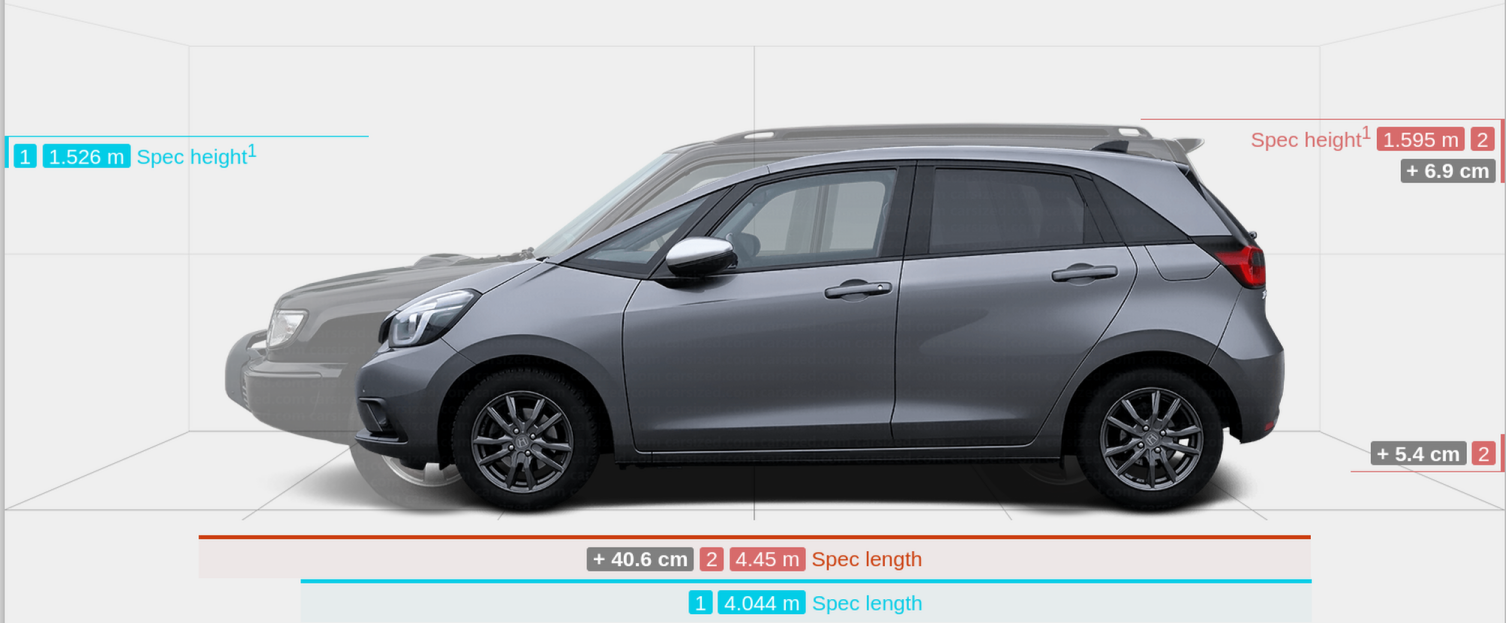
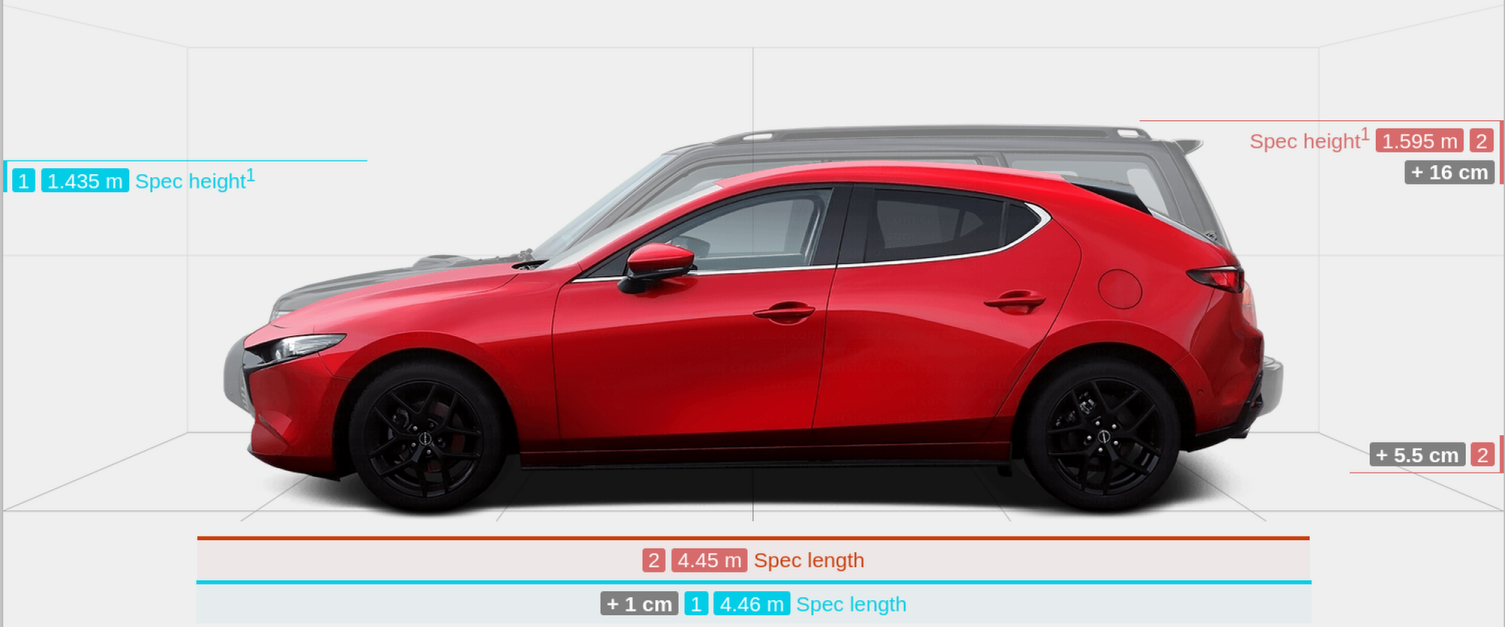
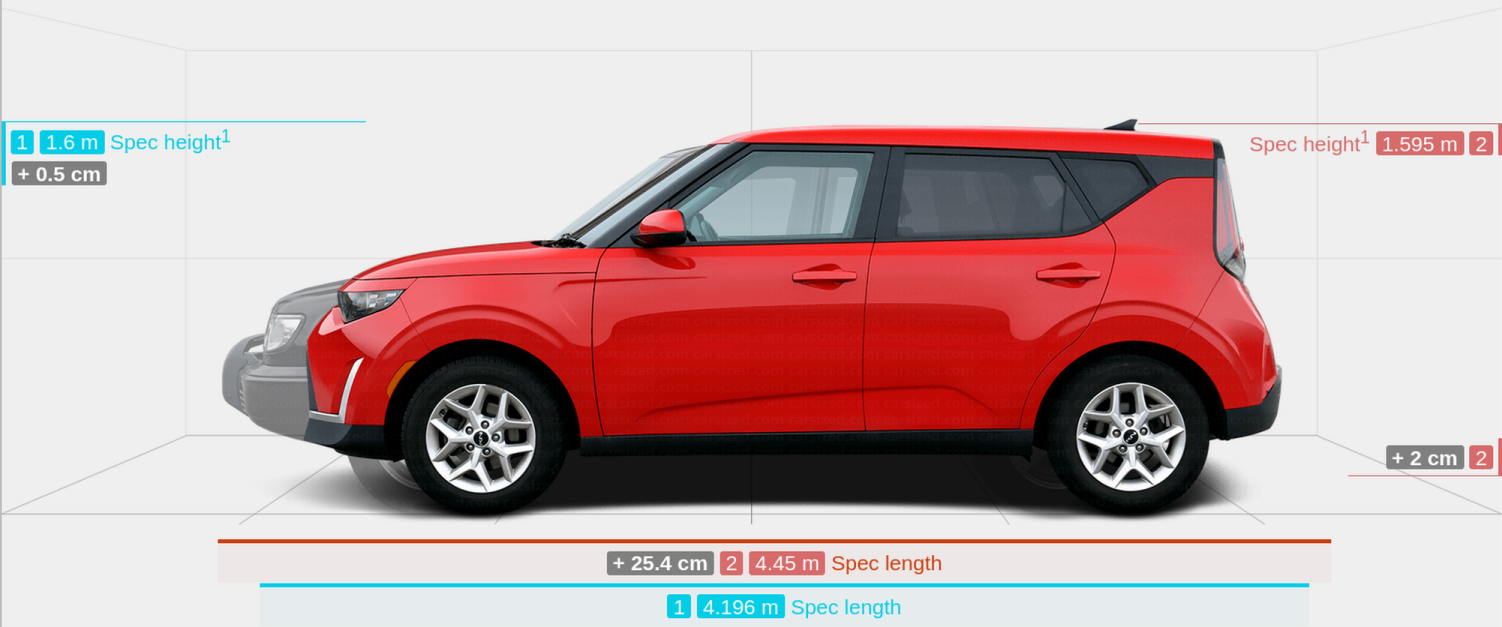
Here are some photos from carsized.com showcasing a first-gen Forester against several modern hatchbacks. The cabin sizes of these vehicles are very similar, and there is minimal height difference between the Forester, Honda Fit or Kia Soul. Only the sporty Mazda3 lacks cargo space due to its sloped roofline, but it still manages to match the Forester in length and legroom. This calls into question whether some, most, or even all hatchbacks are considered Crabs. According to Wikipedia and most vehicle databases, they are typically categorized as either subcompacts or crossovers. But more on that later.
Crabs don't need AWD or 4WD, they don't need a certain volume of cargo space, and they don't need to be boxy-looking. Put simply, Crabs are a genus of vehicle species whose primary purpose is to maximize non-vehicular sport and utility for its users. They must compromise or destroy other attributes (such as beauty, fuel economy, and on-road handling) in order to accommodate as many human lifestyles as possible. This often (but does not always) manifest in designs with tall ride height, large cabins with two or more rows of seats, hatched cargo bays or open beds, and tame, accessible driving mannerisms.
I'm painfully aware of how loose this definition is, but please keep in mind that more constraining definitions are not implicitly more accurate. Before we can investigate the potential contributors to carcinization in vehicles, we must first study the phenomenon itself. This starts with asking: among all the different models being sold in the US right now, how many are Crabs? Has it always been like this?
Methodology
I purchased this rather expensive database of American market makes, models, and classes spanning from 1990-2026 to use as my primary data source, cross-referencing it against my own knowledge, Wikipedia, and some sparser lists I was able to find online. Unfortunately, the data quality was terrible and required weeks of cleaning and validation to be usable. Issues included: misclassified or sporadically-classified models, missing production years, commas used within data cells (how do you fuck up the "comma-separated" part of "CSV"?), duplicate models, models incorrectly labeled as US market, inconsistently listing trim packages as separate models, random notes in data fields, non-UTF-8 characters, and more! Despite all that, it was still the most comprehensive list I could find on the open Internet. Cleaning up their mess was more efficient than learning how to scrape and validate the source data of thousands of vehicles myself.
I would also like to take a brief moment to chastise the curator for failing to include perhaps the most ostentatiously useless vehicle ever invented: the Nissan Murano CrossCabriolet. If you are not familiar with this short-lived 2000s oddity, I implore you to fix that.
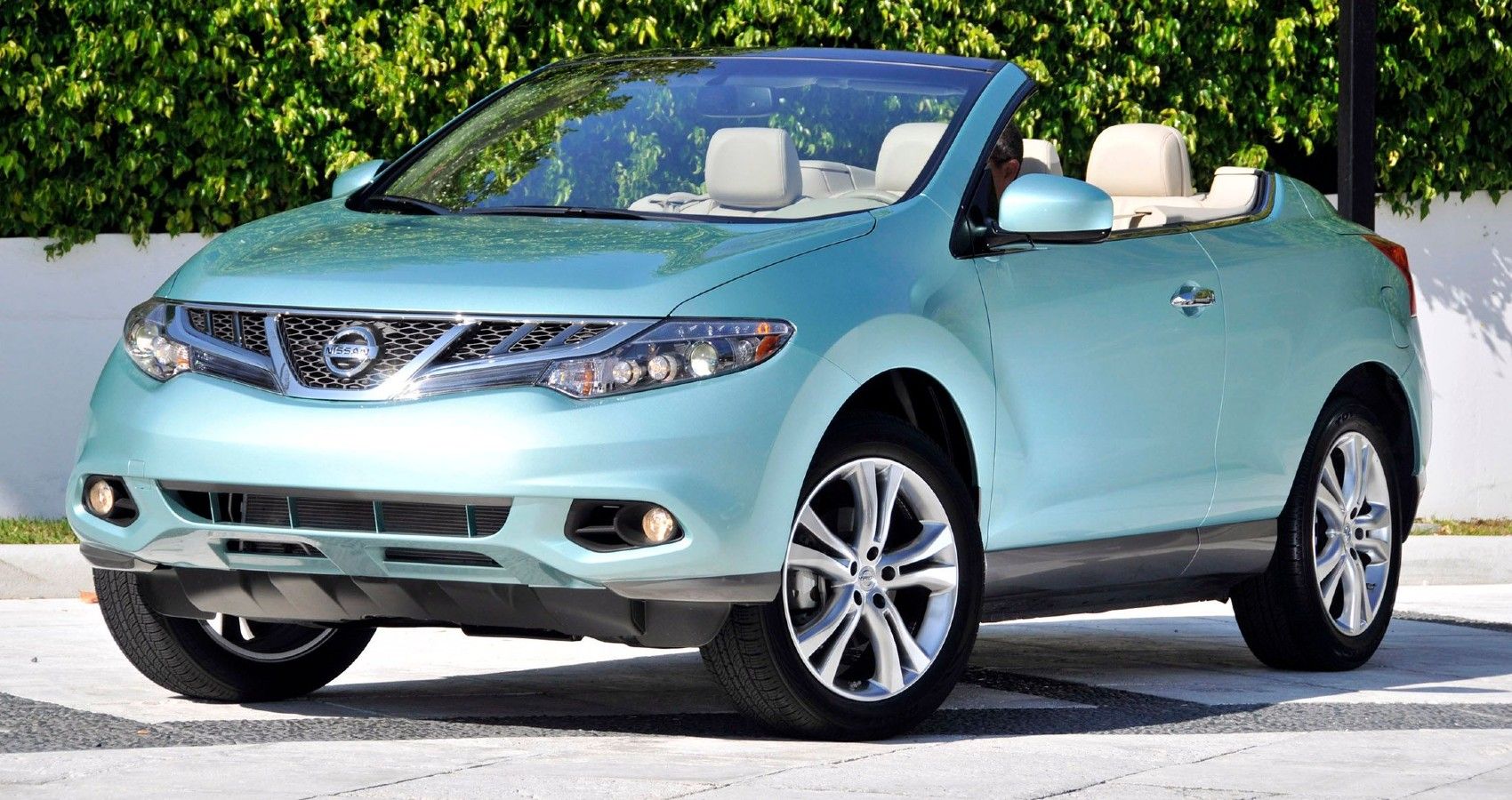
Not that it matters, because I consolidated all convertible variants of vehicles, treating them and their fixed-roof counterparts as one model. In service of identifying how many unique models exist, distinguishing a Murano from a Murano (roofless) is misleading. This is also why I consolidated all trim levels. The Volkswagen Golf, GTI, and Golf R count as one model of car, just as the Audi Q5 and SQ5 count as one model of Crab. Vehicles with EV or hybrid variants fall under the same regard. No other consolidation was performed.
I omit all commercial/fleet vehicles such as Ford's Transit vans or Chevy's Express vans. Gone as well are all supercars and super-luxury makes and one-off models such as Ferrari and the Lexus LFA. For the purpose of this project, I only care about vehicles that are being purchased in significant quantities for nonprofessional use by everyday people. (Though it is worth noting that the latent value proposition of Crabs is so tantalizing that even these boutique companies, known for their racing pedigree and car enthusiast lip service, now offer one or more SUV models for their wealthy clientele. After all, if you can afford one Ferrari, why not get another for the family?)
If you take issue with any of my methodology, I have great news: go fuck around with the data yourself. You can reclassify vehicles you believe are misclassified, make up new species, and change the code that determines which species count as Crabs. The world is your crab - I mean, oyster.
I will note that I spent several sleepless nights rearranging the data, reclassifying edge-case vehicles, and re-binning species as either Crabs or non-Crabs (henceforth referred to as "cars") to see if it affected the results. The answer is not significantly; proof below. The species I ultimately settled on including as Crabs are:
- Compact MPV
- Compact SUV
- Compact crossover SUV
- Compact pickup truck
- Crossover
- Full-size SUV
- Full-size crossover SUV
- Full-size pickup SUV
- Full-size pickup truck
- Full-size van
- Mid-size SUV
- Mid-size crossover SUV
- Mid-size pickup truck
- Minivan
- Pickup truck
- SUV
- Subcompact SUV
- Subcompact crossover SUV
Perhaps most controversially, all consumer trucks count as Crabs because an overwhelming majority of them have four doors and short beds. This species variation arose exclusively to reduce its capabilities as a payload truck and increase passenger/internal cargo capacity - perfect crabby criteria. More on that soon.
I reclassified a few outliers in the database, notably the Subaru Baja which was bizarrely the only instance of "coupe utility". It is a four-door lifted Subaru Outback with a bed. It is not a coupe, but it is mostly utilitarian. Therefore, I binned it as a "Compact crossover SUV" to join other similarly sized and shaped Crabs. The cold truth is that some enthusiasts' favorite vehicle is a crossover in the most literal sense of the word - and that's okay! Crabs can be cool. Wagons were reclassified from various flavors of "sedan" to their own "wagon" class, which I ultimately chose to exclude from the Crab bin. Circling back to aforementioned hatchbacks, I left most of them in whatever class their manufacturer and/or Wikipedia described them as; predominately they were subcompact cars and therefore also excluded. In my entirely subjective and therefore correct opinion, wagons and hatchbacks typically retain most of the characteristics of their driver-centric sedan counterparts (styling, driving dynamics, and lower ride height) while adding some utility in the form of a hatched cargo bay. Since they are not changing their forms significantly or sacrificing enough to become primarily utilitarian vehicles, they are not Crabs. In all other cases, I avoided reclassification unless I considered it absolutely necessary due to being a verifiable error or outlier.
Analysis
Author's Note: The upcoming graphs have a lot of small text on them because I wanted to include the specific values alongside the plot trends, rather than separate them into data tables. To get a closer look, click on any of them to open a full-screen view.
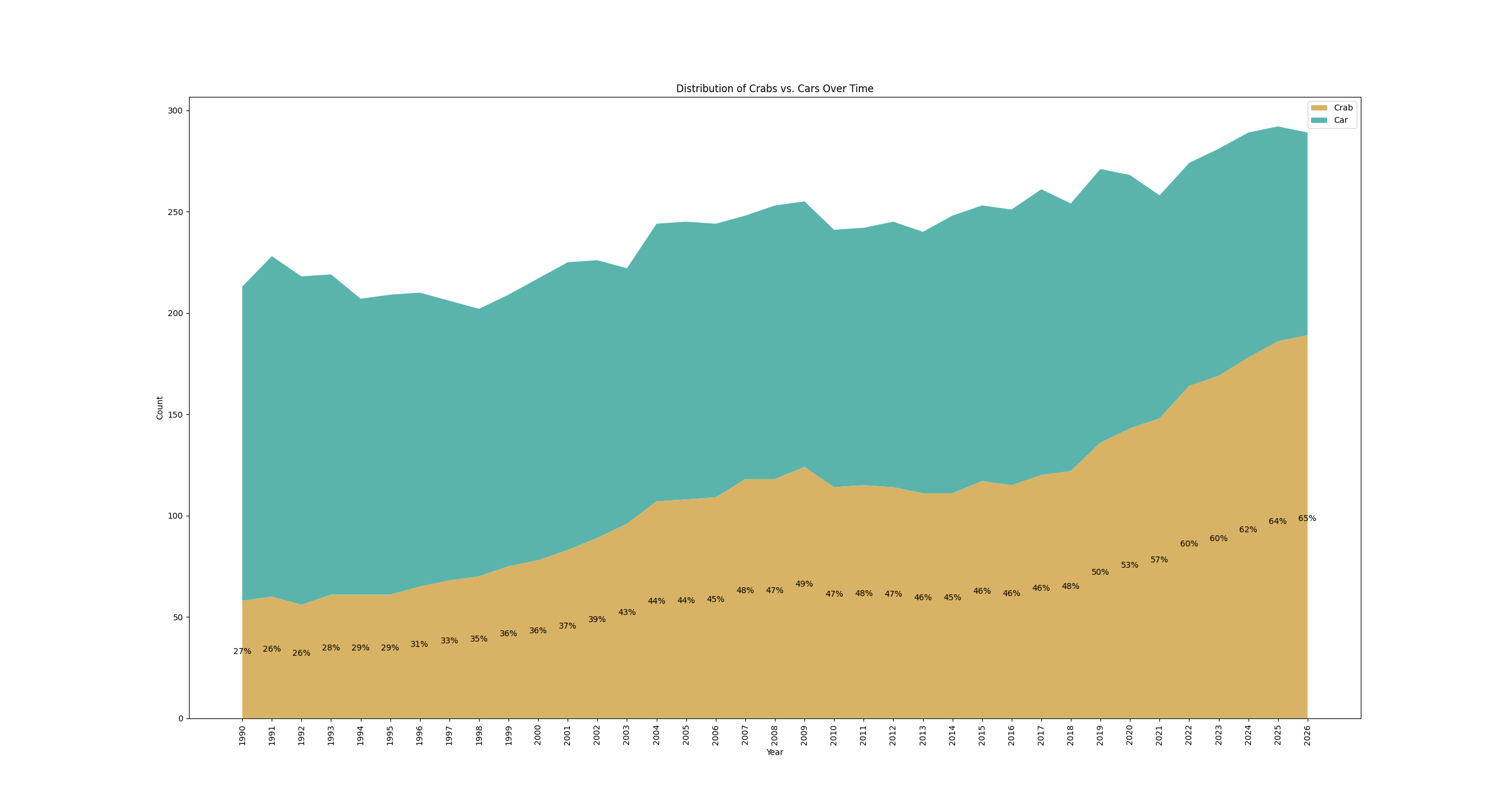
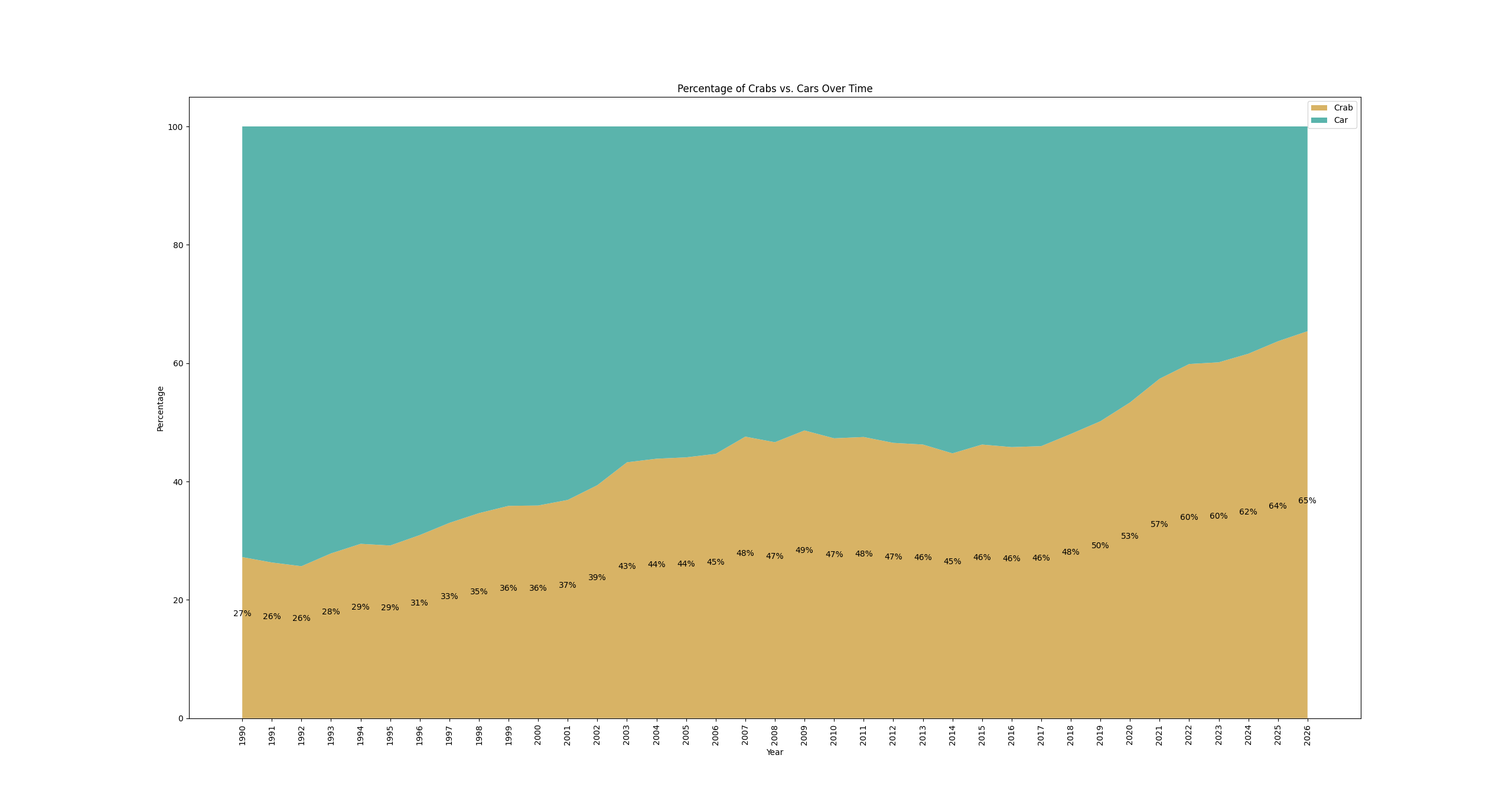
These two graphs show a non-normalized and normalized distribution of Crabs vs. cars in each year from 1990 to 2026. That is to say: for a given year, among every unique model of vehicle for sale in the US market, how many of them are Crabs? The non-normalized view is really only included to demonstrate that the diversity of models has increased considerably over time. Last year we saw the largest variety of models for sale ever! And yet, more of those models than ever before were Crabs. This margin further increased by 1% to 65% this year, likely due to the retirement of several cars (such as Volvo's remaining sedan and wagon lineup) and the introduction of new Crabs (such as the BMW iX3, Genesis GV90, and Rivian R2).
Before we move on, how does the carcinization rate look based on the original, unedited data? No cooking the books or reclassifying vehicles!
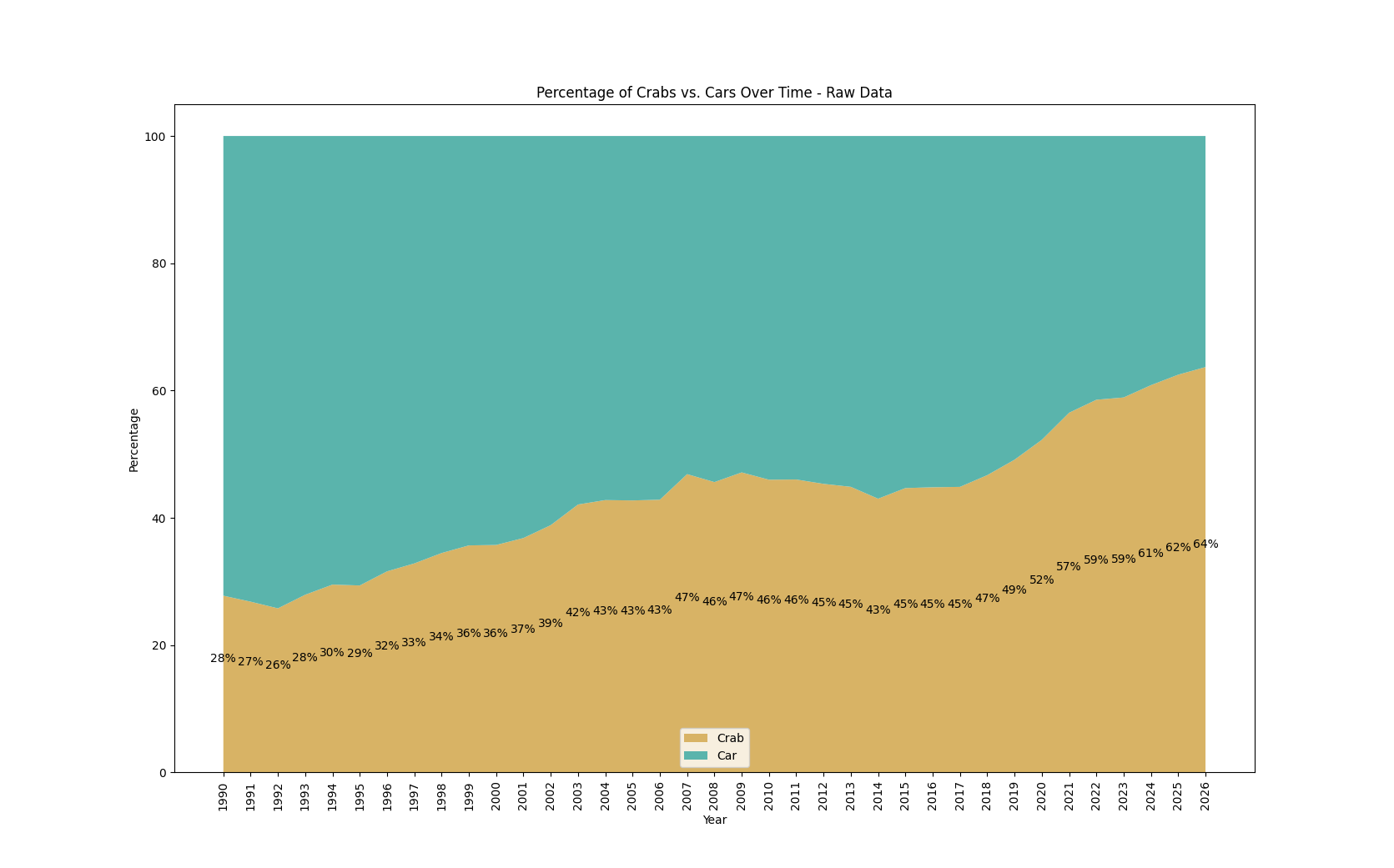
As you can see, it's almost identical. I promised the reclassification and editing I did was minimal, didn't I? How about when we change what classes count as a Crab? Surely I'm just including trucks to inflate the numbers - people own non-fleet trucks to use them for work! They're different from Crabs! Well, first of all, no they don't. This survey conducted by vehicle owner research firm Strategic Vision reveals that 40% of truck owners drive their vehicle purely for pleasure at least once a week, and an overwhelming 90% never use them professionally. This survey was segmented based on truck subclasses (EV, standard, full-size, and heavy-duty), revealing thankfully that larger trucks tend to be used as trucks more often. But it's abundantly clear from the data why all modern trucks have 4WD or AWD, spacious four-door cabins, and tiny beds: people love to use them as Crabs. In a CBS News interview, Ford CEO Jim Farley perched himself on the tailgate of a high-trim, crew cab F-250 Super Duty in a fitted suit jacket, hay bale underfoot, horse racetrack in the background, and said, "This is the modern horse. You can do work on, you can have fun with, you can kind of go anywhere. It's an American lifestyle." Seriously. We cannot write satire better than reality. But for argument's sake, let's see how the carcinization chart looks with trucks classified as cars:
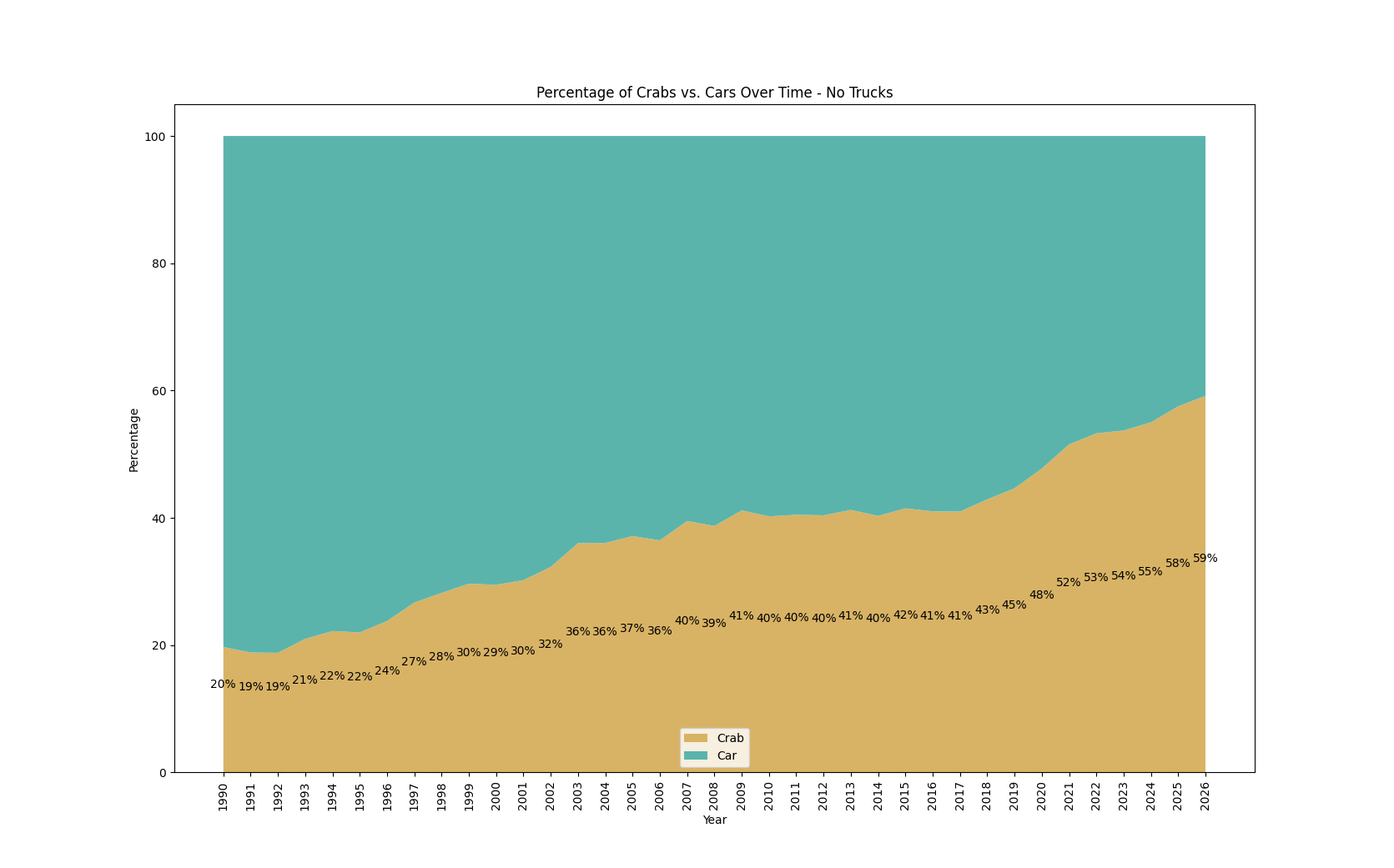
Compared to my original analysis, these results tell exactly the same story. Although the Crab ratio drops, it does so almost perfectly linearly - 6-8% in each year. The 50/50 threshold is passed in 2021 instead of 2020 - barely a difference. By 2026 there is still a significant majority (59%) of Crabs for sale vs. cars and trucks. This provides some additional evidence of why the overall Crab ratio has increased over time despite the increasing diversity of models: most brands, regardless of their historical specialization, nationality, core audience, or size, have shifted their strategies in the twenty first century to include more and more Crabs.
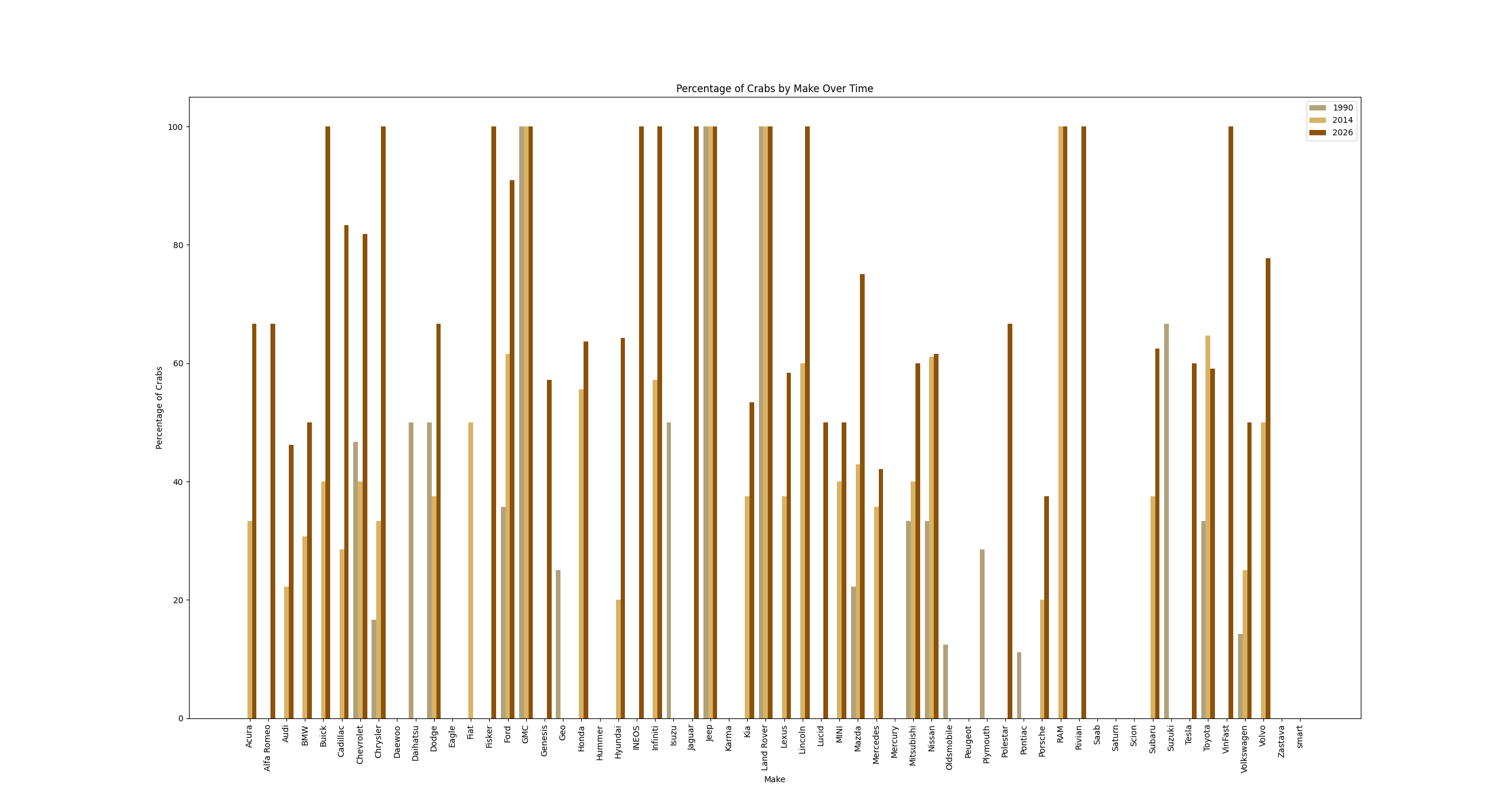
This graph provides a snapshot of three points in history (1990, 2014, and 2026), the midpoint chosen specifically to avoid omitting Fiat's brief flirtatious period of bringing multiple models stateside. The bars represent the percentage of Crabs among all vehicle models offered by a specific make for that year. This lets us observe every makes' carcinization rate at a very generalized level. I've also rendered out each individual carcinization chart which you can browse below for deeper insights. The chart labels refer to the percentage of Crabs among all current models that year. If the make offered no models for sale at all in a given year, the plot is blank there.
First let's assess our home teams. American makes such as Chevrolet, Buick, Cadillac, Ford, Lincoln, and Chrysler have steadily increased the ratio of Crabs in their lineups over time, starting in the late 1990s. Major Japanese brands took notice, with Toyota, Nissan, Honda, Mazda, and Subaru all ramping up in response to stay competitive overseas. Toyota and Honda would be particularly interesting case studies because they established their American brand reputation in the 1970s and 1980s on building small, reliable commuter cars. Yet by 2026 both companies offer more Crabs than cars for sale. Their younger Korean counterparts Hyundai and Kia which built the same reputation twenty years later are once again following in their footsteps after the turn of the century. And what about our beloved Euros, once renowned for their premium executive sedans and touring wagons? BMW, Volkswagen, Audi, Porsche, Mercedes, and Volvo all tell the same tale: more Crabs, fewer cars. As expected, brands which primarily or exclusively produce Crabs such as Dodge, Jeep, GMC, and Land Rover continue along their trajectories, unwavering in commitment to the mighty crabby form.
That's a pretty overwhelming answer in favor of the Crab as the most successful vehicle genus from a proliferation standpoint. They're more prevalent than ever before, and there are more varieties of them each year. And to check in with this project's namesake, here are all the model nameplates which evolved into Crabs:
- Ford Mustang (Mach E)
- Ford Maverick
- Jaguar E (Pace)
- Dodge Hornet
- Mitsubishi Eclipse (Cross)
- Toyota Corolla (Cross)
- Chevrolet Bolt (EUV)
For those who enjoy reading the backs of cereal boxes, here is the full list of vehicles that changed species over the years regardless of carcinized status:
- Buick LaCrosse (mid-size car -> full-size car)
- Chevrolet Trax (subcompact crossover SUV -> compact crossover SUV)
- Chevrolet Trailblazer (mid-size SUV -> compact crossover SUV)
- The bastardized nomenclature of the Chevrolet Blazer deserves an entire paragraph unto its own...so here it is. It began as a two-door 4x4 SUV known as the K5 Blazer in 1969, built on the C/K truck platform to compete against the Jeep and other offroad vehicles. Fourteen years later in 1983, they built a smaller SUV on the S-10 truck platform and confusingly named it the Blazer. (Although the K5 Blazer always received badges denoting its roots, the S-10 Blazer was only ever branded as "Blazer". Wikipedia claims the S-10 Blazer had an "S" badge, however I have never seen one in person nor can I find one among the heaps of online S-10 Blazer photos, so...)
The larger K5 Blazer's four-door variant eventually donned the beloved Tahoe nameplate in 1995 while the S-10 Blazer continued soldiering on as the Blazer until 2005. However, this meant that from 1992 to 1994 the Chevy Blazer was simultaneously a full-size and mid-size SUV. The Blazer name was later revived in 2019 for a new, unibody platform mid-size crossover SUV which remains in production currently. Then there is the related-yet-unrelated TrailBlazer, which originally started as a luxury trim package for the four-door variant of the 1999 model year S-10 Blazer only to be spun off as its own uniquely-styled mid-size SUV from 2001-2008, then later revived in 2020 as a small crossover SUV. So the Blazer's evolution is: mid-size SUV (original K5 two-door) -> mid-size SUV/full-size SUV (S-10/K5) -> mid-size SUV (1995 Blazer) -> mid-size crossover SUV (2019 Blazer). If anyone working at Chevrolet is reading this, I only have one thing left to say:


- Chevrolet Trax (subcompact crossover SUV -> compact crossover SUV)
- Chrysler Pacifica (full-size crossover SUV -> minivan)
- Dodge Avenger (sports car -> mid-size car)
- Dodge Durango (mid-size SUV -> mid-size crossover SUV)
- Ford Taurus (mid-size car -> full-size car)
- Ford Ranger (compact pickup truck -> mid-size pickup truck)
- Honda Insight (subcompact car -> compact car)
- Honda Civic (subcompact car -> compact car)
- Honda Accord (compact car -> mid-size car)
- Honda Passport (mid-size SUV -> mid-size crossover SUV)
- Jeep Wagoneer (full-size SUV -> compact SUV -> mid-size SUV -> full-size SUV)
- Jeep Grand Cherokee (mid-size SUV -> mid-size crossover SUV)
- Lincoln Aviator (mid-size SUV -> full-size crossover SUV)
- Mazda Protege (subcompact car -> compact car)
- Mazda 626 (compact car -> mid-size car)
- Mercury Cougar (sports car -> compact sports car)
- Mitsubishi Mirage (compact car -> subcompact car)
- Nissan Pathfinder (mid-size SUV -> mid-size crossover SUV)
- Scion xB (subcompact car -> compact car)
- Subaru Outback (wagon -> mid-size crossover SUV)
- Toyota Camry (compact car -> mid-size car)
- Toyota RAV4 (subcompact crossover SUV -> compact crossover SUV)
- Toyota 4Runner (compact SUV -> mid-size SUV)
- Volkswagen Golf (subcompact car -> compact car)
- Volkswagen Jetta (subcompact car -> compact car)
Author's Note: If you run the function that generates this list yourself, you'll notice it differs slightly from the list here. That's because for each model, I manually validated its historical classifications and general attributes (size, chassis, style) and only included those which physically changed in a significant way. Data is messy. Trust but verify.
This confirms the popular belief that models get bigger over time as they are refreshed for new generations. Seventeen models from this list grew in size classification over time, whereas only three models shrank. Six models changed species without changing size, primarily SUVs which transformed into crossovers in later generations to exchange offroad capability for ride comfort (based on Wikipedia's definition of crossovers as "SUV-styled vehicles with unibody construction", paraphrased). Anyway, back to the Crabs.
How Did We Get Here
Unlike a natural environment where species variation occurs randomly and persists due to a multitude of factors including sheer luck, vehicles are carefully tailored by manufacturers to appeal to measurable consumer desires while adhering to regulatory standards. Thus, the potential incentives for carcinization within the auto industry are much more constrained and knowable. Let's start with a consumer-focused hypothesis.
Have you ever heard someone come back from a dealership and say this? "Well, I could've gotten a smaller car, but this larger one was such a great value!" Anecdotally, I have countless times. Brands know this and upsize nameplates intentionally to make consumers think they're getting more vehicle for their dollar by upgrading, as proven by the list above. But how much truth is there to that? Is carcinization simply due to consumers' bargain-seeking behavior? We can use longitudinal sales trends to explore financial value deeper.
Kelly Blue Book (a subsidiary of Cox Automotive) published these trends citing both MSRPs and actual sales prices on the incline with an average of over $50,000. (I wish they also published median data, alas.) The most notable finding was this:
"Popular full-size pickup trucks continue to pull the industry average higher. The average MSRP in January for a full-size pickup was above $70,000 for the fifth consecutive month; despite sky-high prices, more than 150,000 were sold. For comparison, the subcompact car segment, where the average MSRP was less than $26,000 in January, fails to attract buyers. Less than 4,000 subcompact cars were sold last month."
Their executive analyst Erin Keating had this to add:
"Consumers are still finding plenty of options below the industry average, especially in core segments like best-selling compact SUVs, but the disappearance of true entry-level vehicles continues to lift the floor higher. At the same time, strong sales of full-size pickups and large, luxury SUVs keep pulling the averages up, proving that demand for high-priced models remains incredibly resilient."
That observation of top-dollar demand will soon be very relevant, so remember it. Overall these sales figures make it abundantly clear that modern consumers appear to be Crab enthusiasts. But do they flock to them because they're a good deal?
This fantastic short research article (seriously, go read it) by Matt Hardigree reveals the truth from the supply side. His findings indicate that not only are Crabs more profitable for automakers compared to cars, but also that companies intentionally reduced production quantity of base trim models during the COVID-19 pandemic (and afterwards) to keep profit margins high during a period of low demand. Aside from proving the long-assumed truth that manufacturers make most of their profit from trim packages, this also indicates that it's in automakers' best financial interest to sell as many mid and high-trim Crabs as possible. Crab-pilled consumers are actually getting the worst deal! The Cox Automotive data doesn't quote manufacturer supply numbers, only pricing and sales figures. But holding these trends next to each other, I wonder if the lack of sales in the subcompact market is not only driven by a lack of demand, but also by a lack of supply. Are there fewer low-trim and small-size cars being produced because high-trim Crabs are more profitable? It seems pretty likely. Unfortunately, it's nearly impossible to get real manufacturing quantity data. Maybe the folks over at CarEdge could come up with approximates using their aggregated dealership data, but I'm not a journalist and can't pay them to run those numbers.
Regardless, two findings are clear. Firstly, the "more car for your dollar" theory is dead. People who think they get good deals on larger vehicles are just getting swindled by salespeople. If you really want to stick it to the dealership, haggle down the smallest base trim car on the lot that suits your needs. Secondly, carcinization is incentivized by automakers' inherent profit-maximizing behavior. Even without production data, the market offerings data I presented earlier provides evidence of this. They have no incentive to design cars (low profit margins) when they could instead design Crabs (high profit margins) which keep them profitable in a wider range of market conditions. The higher margin on Crabs only has room to increase with the advent of EVs. Manufacturers are shifting to skateboard designs which enable them to use the same chassis across multiple vehicles, even scaling easily to accommodate different sizes. This substantially reduces production costs compared to traditional methods - and it's a sure bet that those savings won't be passed along to customers. But if Crabs are such a bad financial value for us, why do we keep buying them? Crabs are typically more expensive than cars, after all. Are people trapped in a Crab-flooded market against their will because manufacturers refuse to make cars?
To answer that, we need to determine how affordable Crabs are for typical households and how popular they are by sales figures. The Bureau of Labor Statistics (BLS) new vehicle Consumer Price Index for All Urban Consumers (CPI-U) dataset uses 1983 as its baseline year, meaning a typical MSRP from that year is required to project vehicle pricing forwards in time. Let's use the 1983 Honda Accord. Although its base trim price was $8,550, it would be more accurate to use the mid-trim price of $10,300 "for the LX automatic four-door sedan", since that accounts for some of the optional features that are standard equipment today. While far from the cheapest vehicle on the market at the time, the Accord is a great "typical" pick due to being regarded as an affordable, common, and multi-purpose vehicle of its era. Projecting its MSRP into 2024 results in a modern vehicle price tag of $18,300. However, it's almost impossible to find something within that budget! There's only a single candidate cheap enough: the Nissan Versa sedan, with a 2024 MSRP of $17,800. This poses a huge problem because as you may suspect, the Nissan Versa is a far cry from a typical car in 2024. So what gives?
Author's Note: the MotorWeek source for the Honda Accord's price claims to be a MY 1984, however it's actually a pre-facelift whose production ceased halfway through MY 1983. Therefore, the pricing stated in the review is accurate to use as a CPI baseline value.
CPI tells a one-note story about pricing. It struggles to compare products from different time periods fairly because in reality, technology advances and expectations change. Vehicles today can't be optioned with power steering, ABS, traction control, airbags, backup cameras, infotainment systems, or air conditioning; for better or worse, those are all standard issue on even the shittiest base-trim econoboxes. Vehicles are more powerful, spacious, comfortable, and safe than ever before. But all these features add cost. Even Car & Driver glumly notes in their review that "the 2024 Nissan Versa is the last bastion of cheap transportation", an anachronistic outlier in the modern marketplace. If I were to make an educated guess, I'd bet that the base model Versa was a loss leader product produced and sold in tiny quantities. C&D adds that in base trim it lacks common features such as Android Auto/Apple Carplay, remote start, and "a center console with an armrest" (wow). Adding those features in by jumping to a higher trim level also jumps its price by four thousand clams, dangerously close to the better-equipped and more reliable 2024 Honda Civic and Toyota Corolla. In 1983, $10,300 could buy a Honda Accord - a vehicle whose fit/finish, handling, and features were lauded by Motorweek as a gold standard. They considered it a premium-feeling and premium-priced commuter car of its time. If you were to spend comparable money on a vehicle today, you'd end up in what C&D describe as "likely too spartan for all but the most miserly buyer". But remember that a 1983 Accord would be called the same today, if not worse! It doesn't even have power windows or two side mirrors. The standard of what is acceptable for a vehicle, let alone what is considered premium, has changed dramatically in forty years.
Now let's assess buying power. The US census historical income tables provide that data with no adaptation necessary. This can be used in conjunction with our CPI-derived year-over-year vehicle MSRP data for comparison.
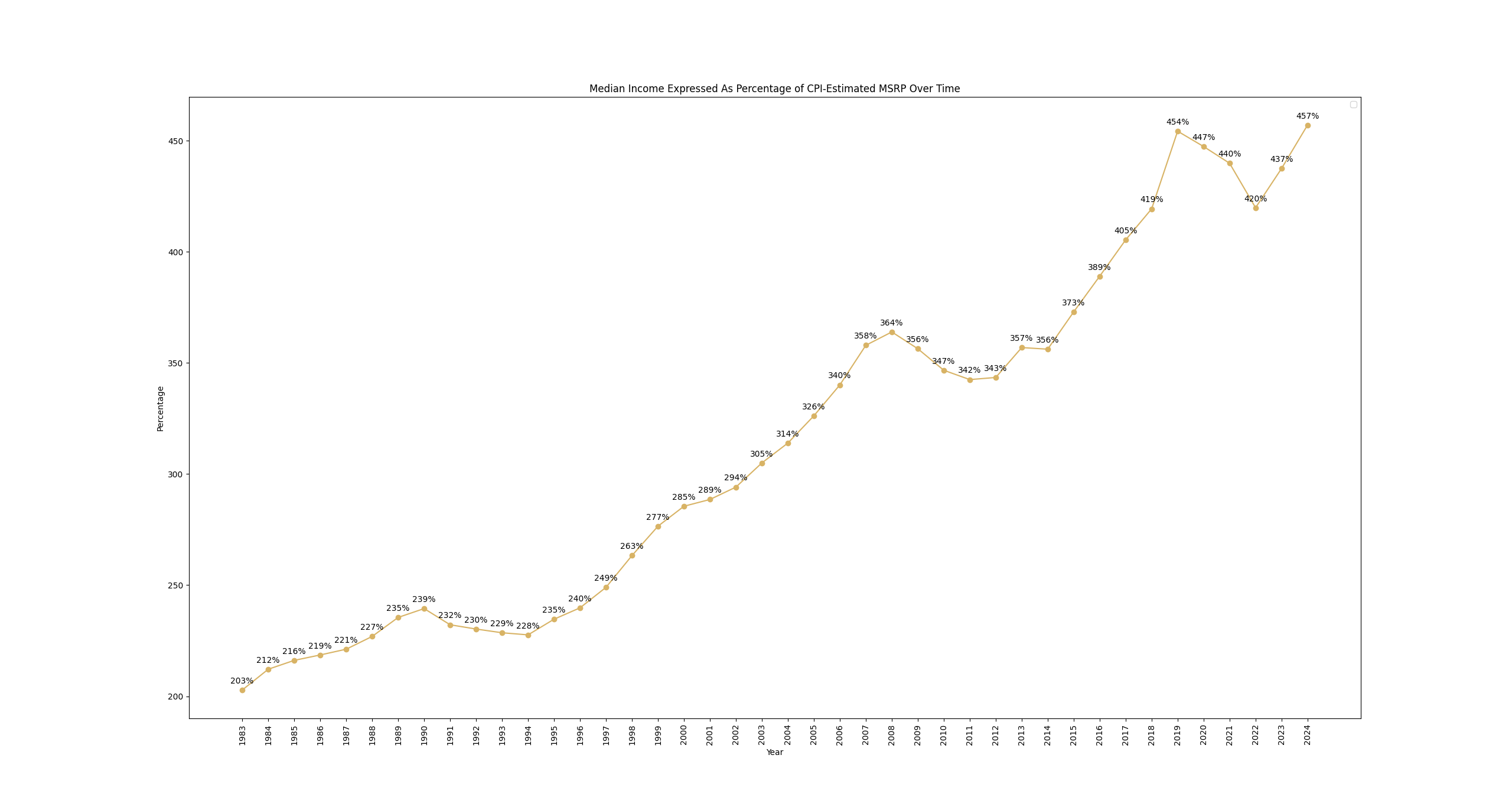
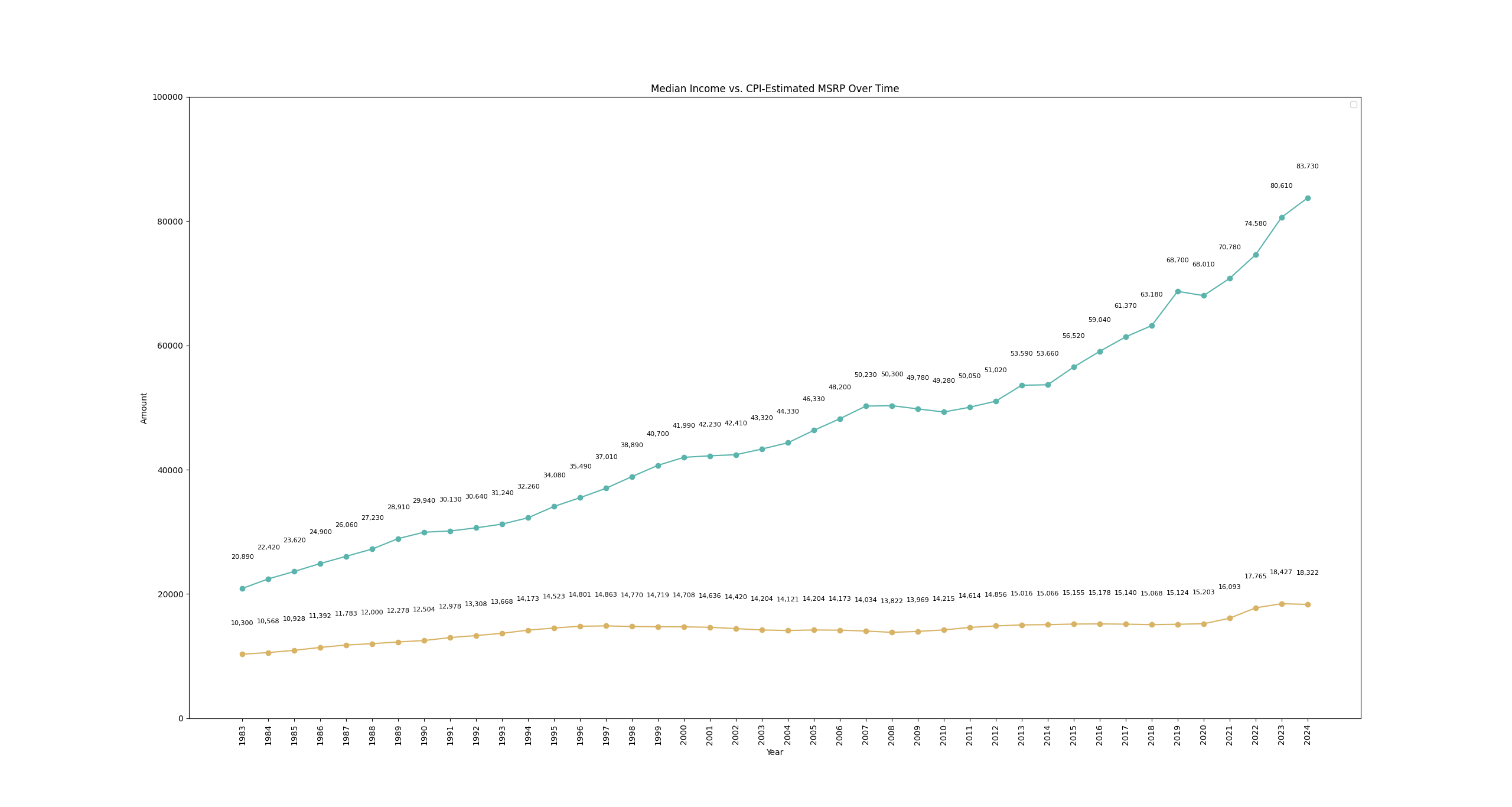
The first graph depicts the ratio of median household income to our "typical" vehicle MSRP. The graph below that shows the individual plots of median income and estimated vehicle MSRP so you can see the exact values. The picture they paint is very optimistic! Consumer buying power has more than doubled in the last forty years relative to vehicle pricing. While a car cost about half your income in 1983, in 2024 it cost less than a quarter. I spoke to a finance professor and read her personal finance textbook's chapter on vehicle purchasing to get some harder numbers. After taxes, the 2024 median household's take-home pay is about $69,700. If they practice good budgeting behavior, they should allocate no more than 10% of their monthly take-home on a vehicle payment. Assuming a loan term of 48-60 months, an interest rate of 5-7%, and a down payment of $2,000, they can afford a vehicle that costs up to a range of $27,200-$31,300. That's substantially above the CPI-estimated MSRP of $18,300! No wonder consumer's standards have risen so much. They're comfortably positioned to enjoy a brand new mid-trim small vehicle or base trim midsize vehicle. If they prefer buying used, CARFAX indicates they can buy any class of vehicle they desire for $30,000 or less, with trucks, luxury SUVs, and luxury cars only two to four thousand above that cut - well within reach with a bigger down payment. They have no need to settle for a base trim Sentra in today's market (even if it would be a much thriftier decision)...
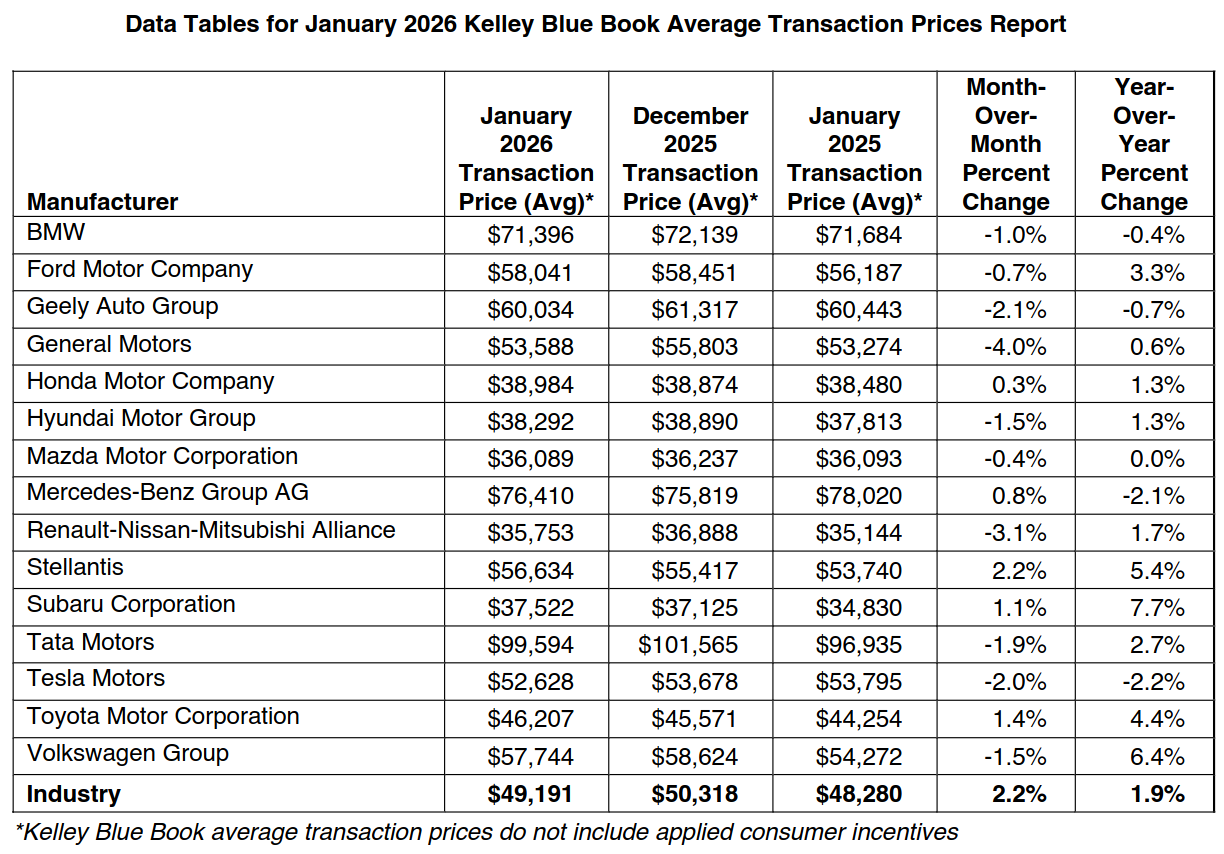
...Except that's not what people are doing. As revealed earlier, the average transaction price has crossed $50,000 and that figure is largely inflated by trucks. This Forbes article reveals just how popular this species of Crab is - they are the leader of vehicle ownership by class! Trucks account for "[...]170,239,357 private and commercial vehicle registrations in 2022, compared to 98,573,935 vehicle registrations for cars". (Yes, that includes fleet trucks, but it also includes fleet cars like rentals and taxis.) That's a whopping 72% more trucks. LendingTree updated its auto debt statistics for 2026, showing a continuing and alarming trend of rising average new car payments. The current average is $767/month, far above the $581/month spending limit of our 2024 median household - and I assure you median income has not increased enough to cover that gap in one and a half years. Obviously, average is not equivalent to median. There are households than can afford more and spend more, and the average used car payment is within bounds at $537. But that's still pretty close to the limit, and between raw sale quantities, pricing data, and year-over-year lengthening repayment schedules, it's safe to conclude that most Americans are buying much more vehicle than they can afford. As one final nail in the coffin, here is Cox Automotive's data for January 2026 average transaction prices, sorted by manufacturer:
To recap, here are our financial findings:
- Many vehicles (including Crabs) are financially within responsible reach of the median household.
- Consumer standards have sharply increased in forty years (and supply has shifted to reflect that).
- Trucks are by far the most popular vehicle species.
- New vehicle payments are way above what most people can afford, and used payments are near the ceiling.
The verdict: American consumers are in love with Crabs to a problematic degree. This isn't a one-sided relationship of brands stuffing Crabs down everyone's throats to jack up profits - this is willing, widespread endorsement of unnecessarily larger, more expensive Crabs. There is a huge variety of well-equipped vehicles, cars and Crabs, below a median household's responsible budget. In our modern era of internet dealerships, nobody has the excuse of being unable to find exactly the make, model, and trim they desire (yes, even a Nissan Murano CrossCabriolet). Yet affordable vehicles are far less popular than overpriced luxury trucks in terms of actual sales, and on average expensive Crabs dominate the sales charts. Even if manufacturers are underproducing cars to increase Crab sales, it's overwhelmingly evident that both sides want this.
Is our habit unsustainable? Well, maybe. I'm not an economist and it's not my place to make market projections. My carcinization plots show it's been sustainable for thirty years, with only a brief pause in the 2010s following the Great Recession. But that was a pause, not a reversal of course. In hard financial times, people continued driving what they already owned and brands waited on altering their lineups. If gas becomes so expensive that it significantly impacts someone's travel expenses, there are a plethora of electric and hybrid vehicles for them to choose from - predominantly Crabs, of course. After all, the fifth best-selling vehicle of 2023 was the Tesla Model Y. That being said, even though vehicles are more affordable than ever, they are also more expensive than ever.
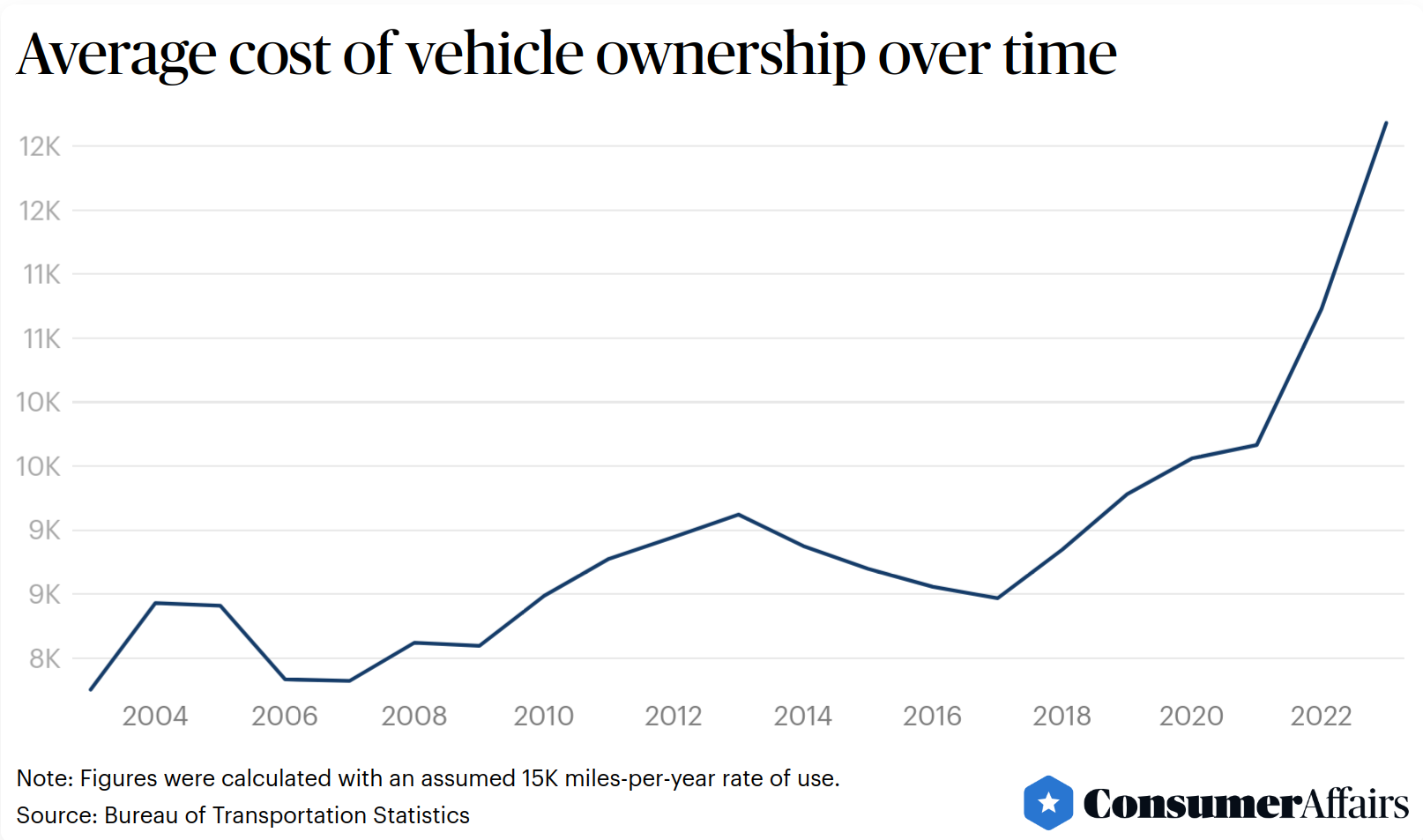
We are swiftly approaching an era in which vehicles are so large and feature-laden that brands won't offer anything below $25,000. Soon, MSRPs will be scraping against the spending limit of our median household, pricing most folks out of new vehicles and forcing them into the used market (for better and worse). Based on purchasing trends, does this mean the used market of the near future will be predominantly mid-trim four-door trucks and luxury crossovers? When demand increases on the used market, those prices will quickly rise above the household budget as well. If most consumers get priced out of a Crab-dominated market, will manufacturers change tune and design more cars again? Based on this analysis, the only certain environmental factors for carcinization so far are Crabs' profitability for manufacturers and their pleasure for consumers. If those benefits continue to hold and our poor spending habits continue to go unpunished, there is no reason for vehicle evolution to change course.
The Elephant-Sized Frog In The Room
Author's Note: I dragged my feet and went back and forth about this last section of analysis - not because it's unimportant but because writing about legislation is tedious. I'll do my best to keep it as succinct and entertaining as possible. Promise.
Hopefully it's clear by now that carcinization is neither solely the consequence of consumer lust or manufacturer greed. As expected, every environmental component of the automotive landscape analyzed thus far has an impact on vehicle design and prevalence. But there is one yet-unturned stone which has courted enthusiast scorn since the dawn of the automobile: government regulation. And I empathize with them. It's undeniable that the Corporate Average Fuel Economy (CAFE) standards created during the fuel crisis of the 1970s forever changed the automobile. But not a single enthusiast I've met has been able to articulate exactly what part of them ruined vehicles. They can't get further than, "Uh, regulations are bad", even when pressed. So if you are a car enthusiast and you'd like to win your next Facebook debate, shut the fuck up and buckle the fuck in. Let's go.
With CAFE, Congress quite literally defined and ushered in a new era of more fuel-efficient gas engines and established a legal precedent for the National Highway Traffic Safety Administration (NHTSA) to continue shaping the automobile's future through federal oversight. From the late seventies until the late eighties, cars got smaller. Engines got smaller. Efficiency went up. Horsepower went down. It's worth noting that none of the regulations mandated smaller vehicles - they were solely targeting fuel economy. But researching and developing more efficient engines took time - in order to meet those standards immediately, automakers had to chop down vehicle size and cylinder count. This would be even more evident if I had carcinization data going that far back, but alas the best source I could find was a citation in page 257 of NHTSA's 2024-2026 Final Rule of an 80% passenger car fleet mix in 1975. Feel free to do your own research to verify that finding, but it should be fairly obvious that the vehicle market of the seventies and eighties was relatively devoid of Crabs. Manufacturers hadn't figured out how to cheat the system (yet).
CAFE drew tremendous ire from car enthusiasts, industry, and news media alike. Journalists concocted the "malaise era" phrase we still whip out today to recall the late seventies and early eighties as an embarrassing stain on American economic and automotive history. (Originally, the term was born out of a speech given by President Jimmy Carter in 1979, which became known as the Malaise Speech despite not containing a single utterance of the word. This is a remarkable shame because setting aside Mr. Carter's own lackluster politics and capabilities as President of the United States, it's a damn good speech. It berates our overdependence on foreign oil, the rise of consumerism as ideology, and a "crisis of confidence" among our national culture, all while rallying for improvement through strong corrective policy and individual action. Instead, it seems history will remember the words as nothing more than a harbinger of depression.) But this was a short blip, not a long drought. By the nineties, manufacturers' investment into R&D was providing great returns. Engines emerged which were both fuel efficient and powerful. With this came the steady upsizing over the next three decades I charted in the Analysis section. Vehicle technology may have changed forever, but vehicle design sought a quick return to its "bigger and faster" roots.
The very same regulations are still around today, reviewed regularly by NHTSA and published in the form of Final Rule documents. But is all this legislation partly to blame for our vehicles getting bigger? What about carcinization? Did Big Brother create the Crab?
I am not a lawyer, so I worked with one to tackle this case. The single most important thing to understand about CAFE standards is that they are divided into two categories: one for "passenger cars" and one for "light trucks". The standard for light trucks is significantly lower and has been since CAFE's inception in 1975. According to the 2024-2026 Final Rule, the 2026 target for passenger cars is 59.4mpg whereas the light truck target is 42.4 mpg. Keep in mind that these are targets, not mandates. NHTSA recognizes that:
"Because manufacturers do not comply exactly with each standard in each model year, but rather focus their compliance efforts when and where it is most cost-effective to do so, 'estimated achieved' fuel economy levels differ somewhat from 'estimated required' levels for each fleet, for each year." (Emphasis mine.)
They also recognize that "any overcompliance is highly-manufacturer dependent", which is probably about as close as you can come to vagueposting at the Big Three for lagging behind the curve without calling them out.
Speaking of call-outs, here's a fun aside. In the 2005 edition of NHTSA's CAFE proposal, they actually threw shade at GM:
"As a result of the Stage Analysis, we have tentatively concluded that, for MYs 2008-2010, General Motors is the least capable of the manufacturers that have a significant share of the light truck market. To ensure that the proposed Unreformed CAFE improvements would not lead to economically severe consequences for the industry, we have given particular regard to General Motors' projected capabilities when balancing the statutory factors to arrive at the proposed standards."
That's right, GM is so bad at making fuel-efficient vehicles that NHTSA lowballed to accommodate them! And what did GM do as thanks? They doubled down on trucks and went bankrupt. Typical.

And speaking of curves, although the target numbers cited above are easy to digest, they don't tell the full story. CAFE's most important guidance comes in the form of curves. Once again, there are separate target curves for passenger cars and light trucks.
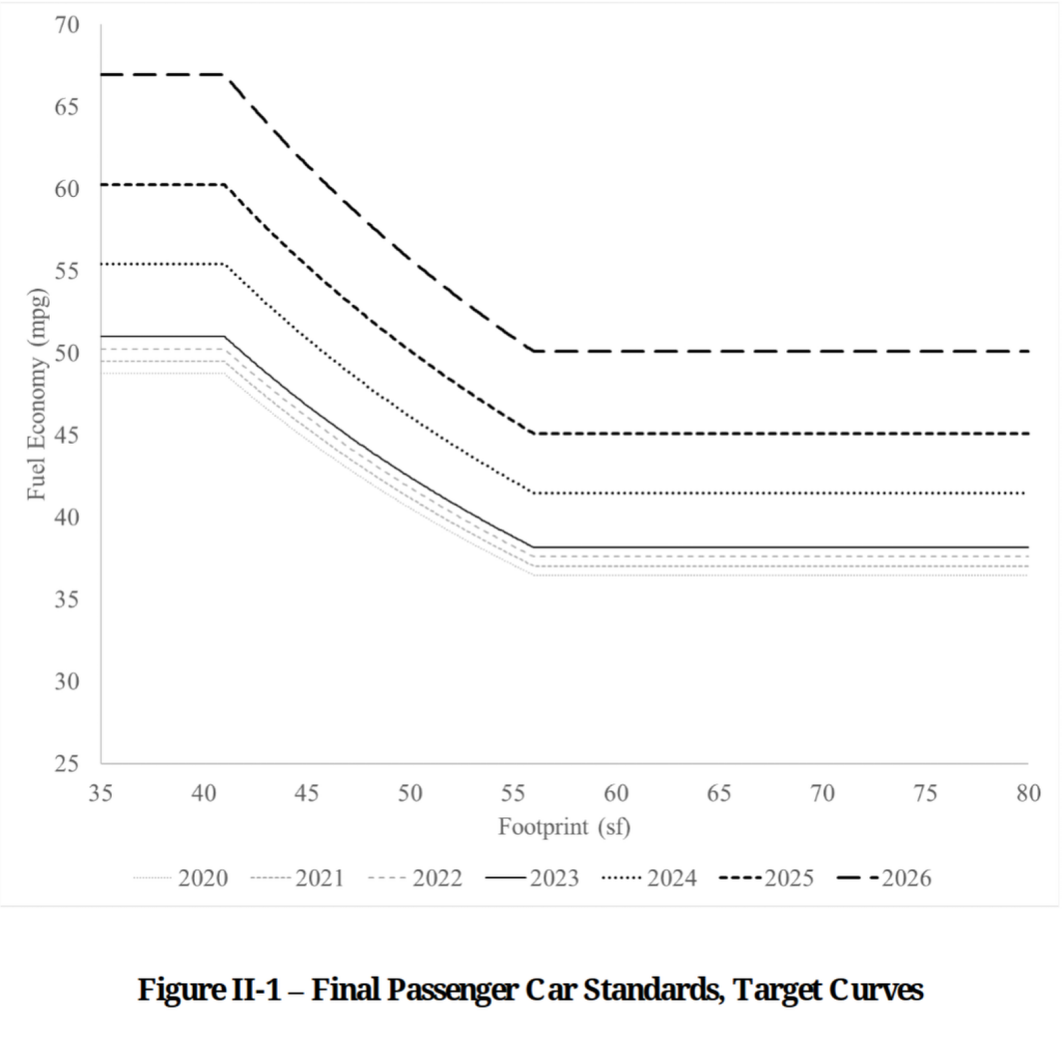
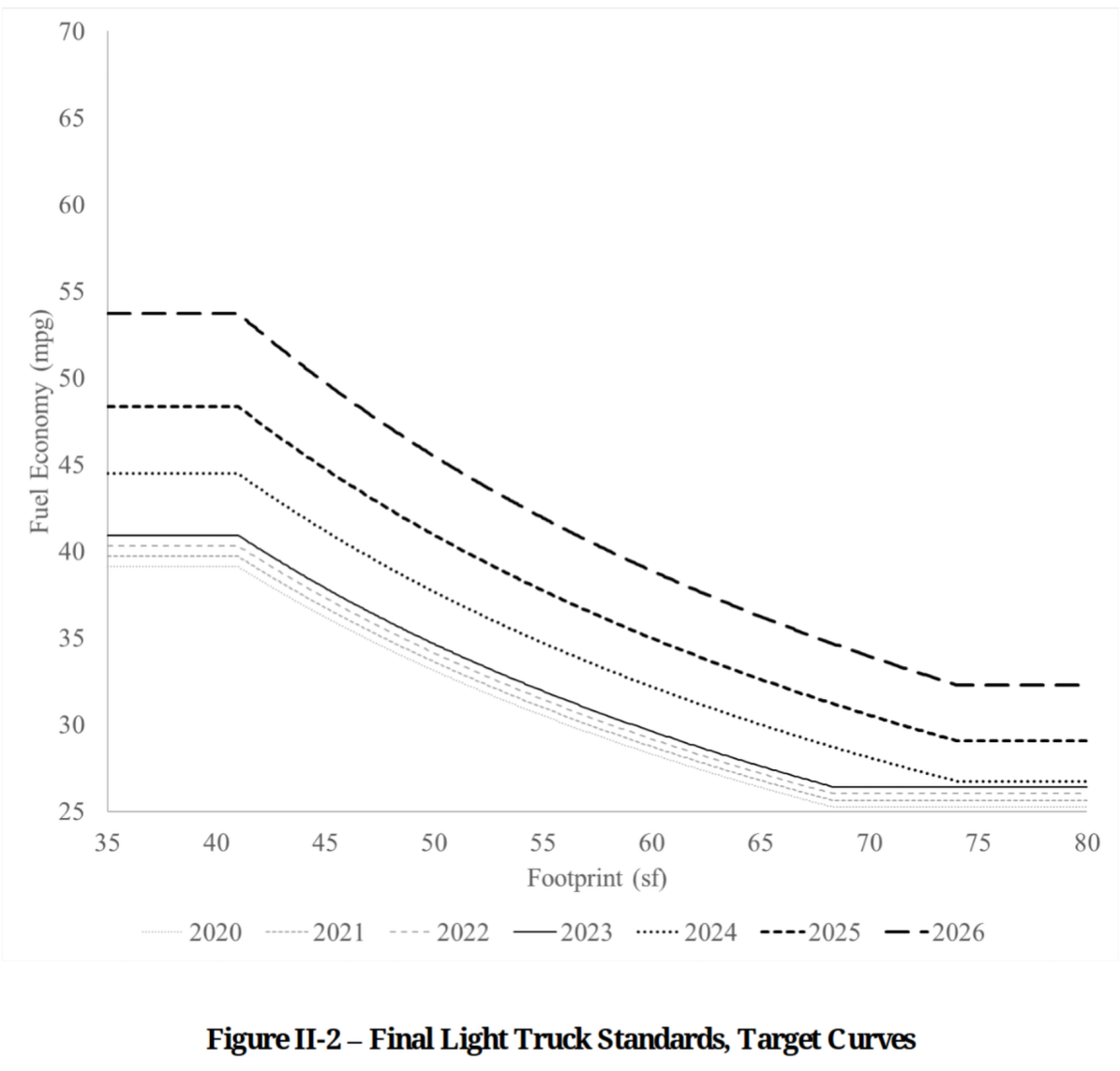
Take note of the x-axis, which refers to vehicle footprint measured in square feet. The curve lowers as footprint grows. Additionally, the light truck curve takes longer to flatten than the car curve. In NHTSA's own words:
"Generally, passenger cars have more stringent targets than light trucks regardless of footprint, and smaller vehicles will have more stringent targets than larger vehicles. No individual vehicle or vehicle model need meet its target exactly[.]"
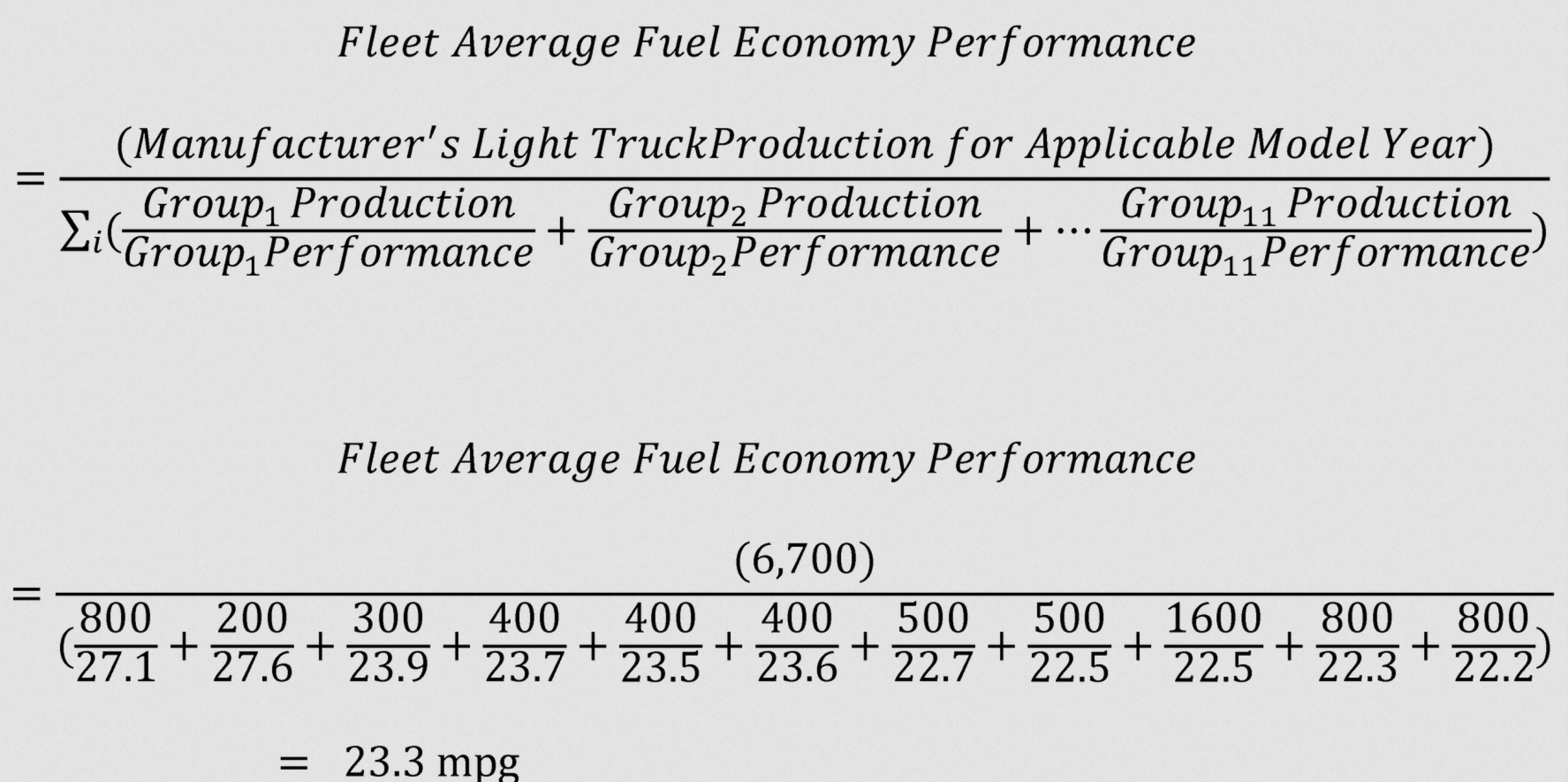
These curves inherently incentivise vehicle upsizing. With each passing year, CAFE standards become incrementally more stringent and manufacturers assess the cheapest ways to comply. For an existing model, one obvious answer is to make its footprint slightly larger so that it gets graded lower on the curve. Consumers win by getting a "bigger and better" new vehicle, and automakers win by minimizing fuel economy improvements (and thereby minimizing R&D cost). This advantage is further demonstrated by the footprint-specific equations used to derive fleet average fuel economy. Here's what they use for light trucks:
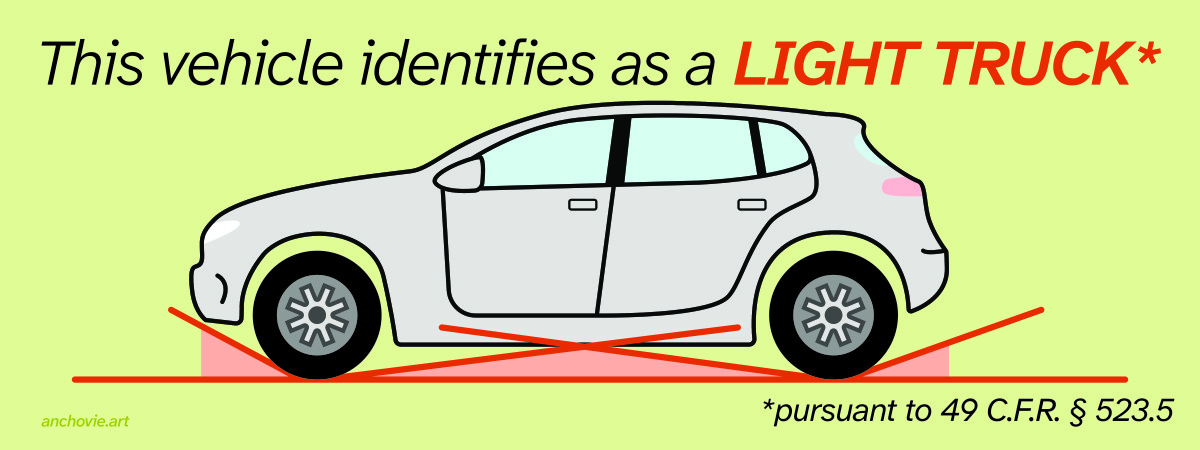
But what the hell is a light truck, anyway? In Part 523 of the Electronic Code of Federal Regulations (eCFR), a light truck is "a non-passenger automobile meeting the criteria in § 523.5." (I simplify the legalese where able to - if you want to read all the word-mincing, be my guest and click the links.) Any vehicle is considered a light truck if it's designed to meet certain cargo-carrying criteria, OR:
- [Be] capable of off-highway operation, as indicated by the fact that it:
- Has 4-wheel drive; or
- Is rated at more than 6,000 pounds gross vehicle weight; AND (emphasis mine)
- Has at least four of the following characteristics:
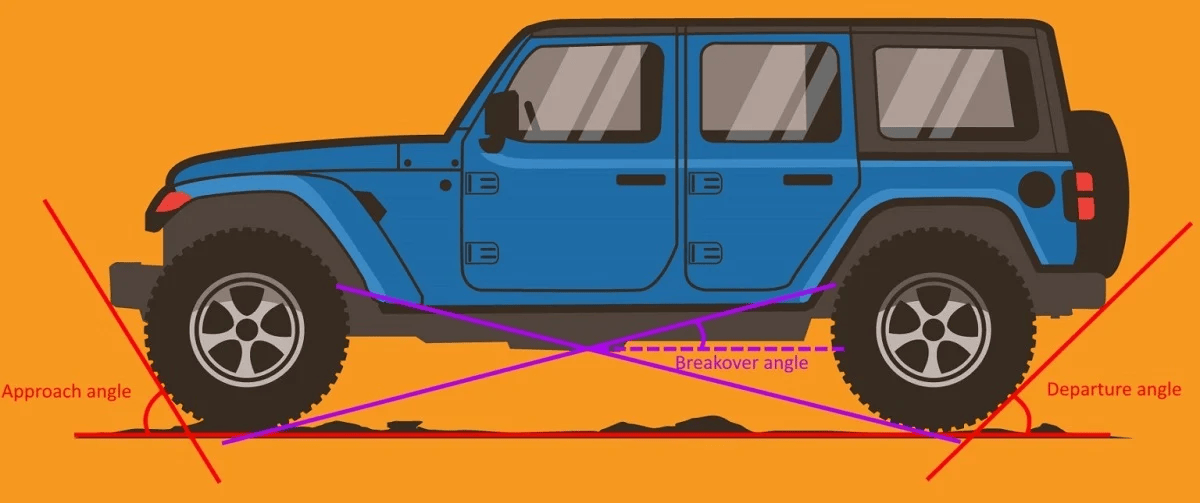
- Approach angle of [at least] 28 degrees.
- Breakover angle of [at least] 14 degrees.
- Departure angle of [at least] 20 degrees.
- Running clearance of [at least] 20 cm.
- Front and rear axle clearances of [at least] 18 cm.
These "off-highway operation" alternative criteria are a smoking gun somewhat ignored by CAFE critics, probably because the vehicle footprint loophole is easier to understand. Here's what those angles are, courtesy of JDPower:
And here's how those angles look, as defined by NHTSA:
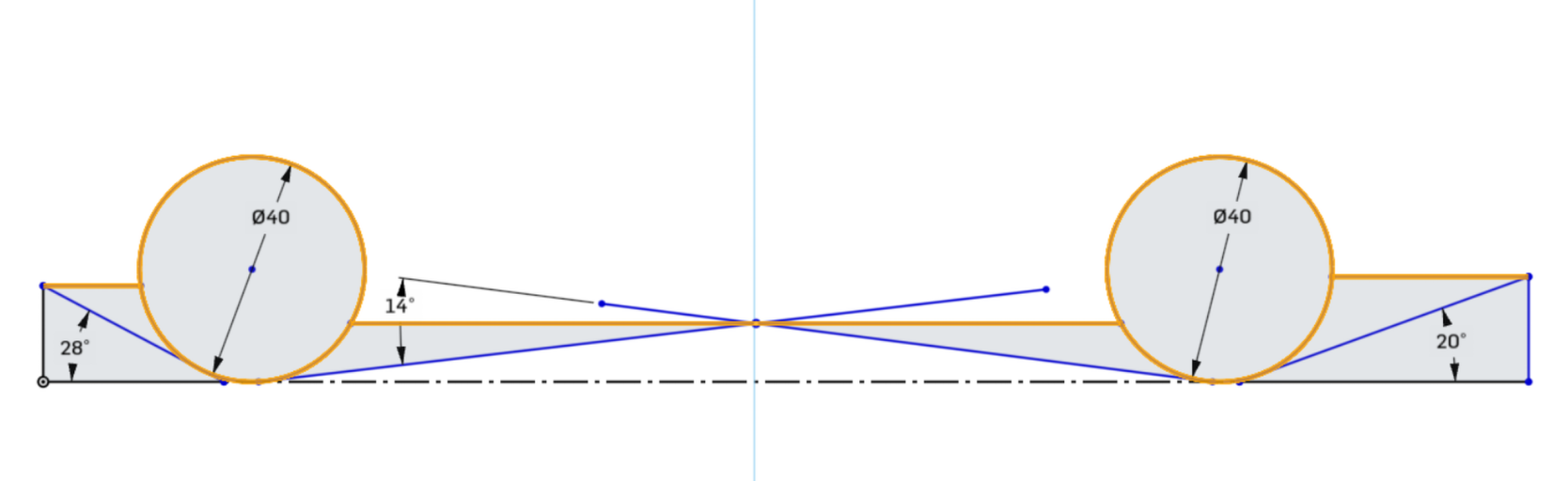
Yellow lines indicate the vehicle boundaries that are referenced when measuring (bottom of front bumper, tires, floorboard, and bottom of rear bumper). Blue lines indicate the angle measurements. (The dimensions for the wheels are meaningless, I just need them to constrain the CAD model.) As you may be able to imagine by projecting a vehicle's side profile onto this schematic, it's easy to design a Crab which fulfills these criteria. For instance, here's a diminutive, unassuming Crab known as the Hyundai Venue:
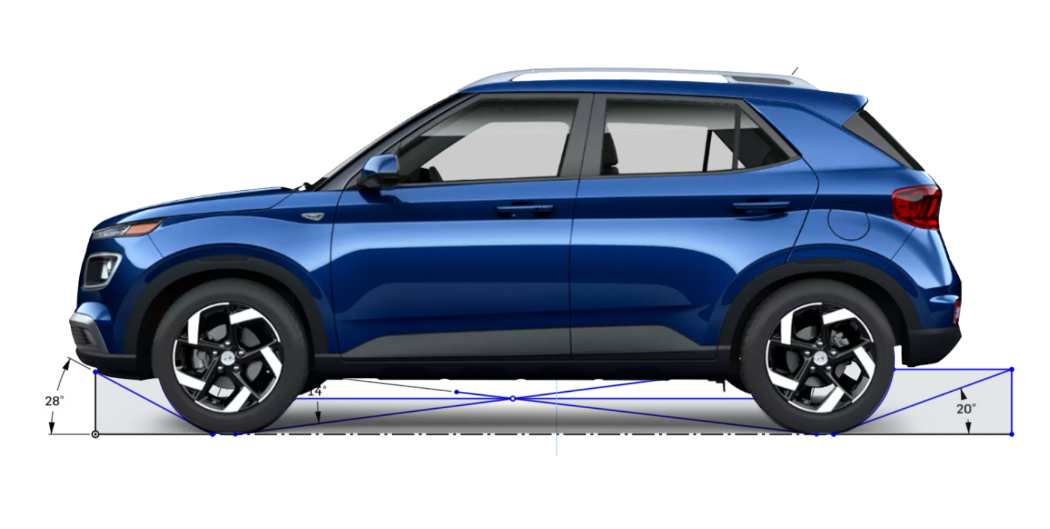
Now the Venue's running clearance is only 17cm and it's not currently offered in AWD. Therefore, it is not considered a light truck and is instead held to the passenger car fuel economy curve. But what is the cheapest way for Hyundai to improve the Venue's compliance in the future as CAFE standards rise?
- Revise the existing engine (wrong)
- Design a new engine (wrong)
- Make the body more aerodynamic (wrong)
- Make the whole vehicle bigger (correct, but not as cheap and may not align with Hyundai's product mix strategy)
- Add AWD and increase ground clearance by 3cm (correct)
Suddenly, with these two simple changes it becomes a light truck in the eyes of the Feds. Does this formula remind you of anything?
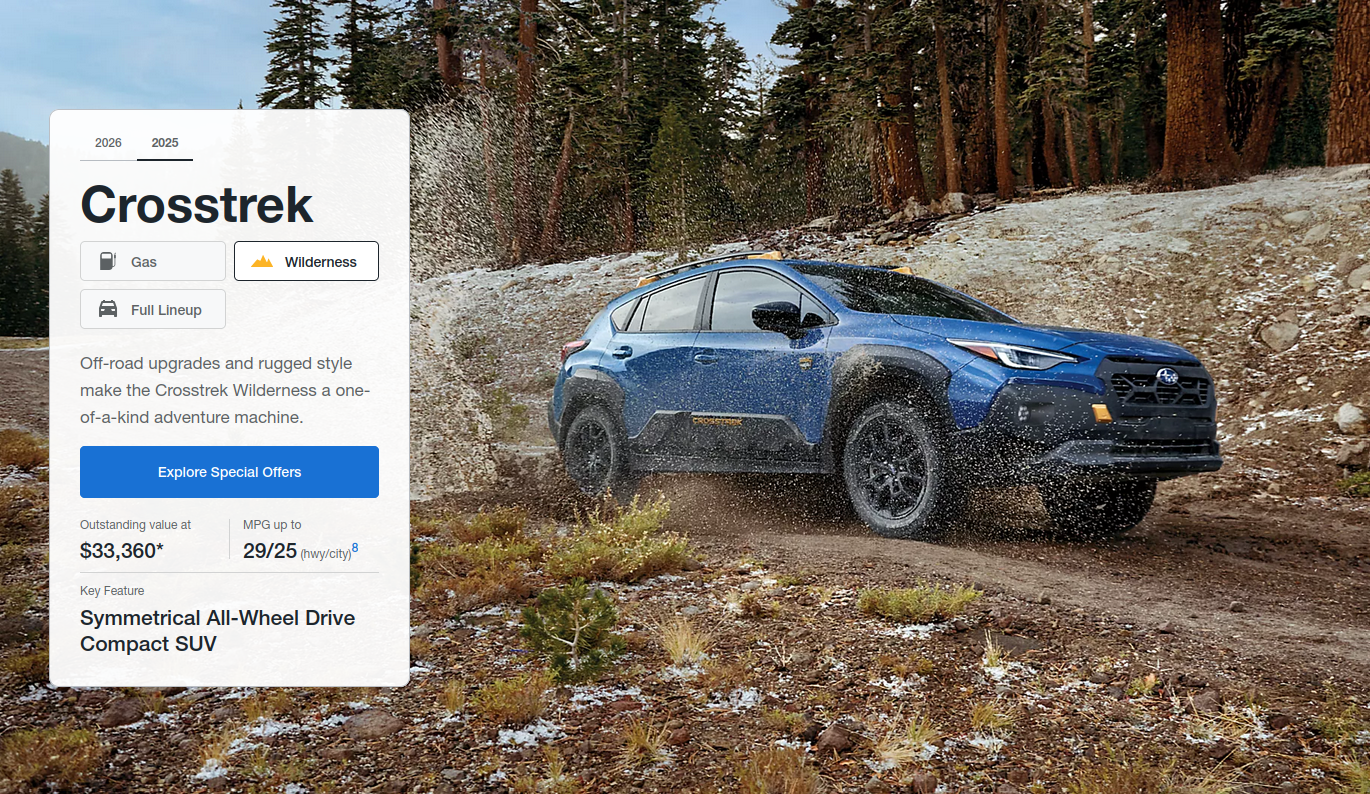
Nested within several hundred pages of administrative faff, we've discovered a shockingly-good recipe for carcinization. Want to design a new vehicle? First, maximize ride height and wheelbase without alienating your target demographics. Next, add stubby front and rear bumper profiles - a long nose or tail simply won't meet the target angles. And don't forget a sprinkle of all-wheel drive! Your new vehicle is now a light truck subject to its lowest possible CAFE standard, resulting in the minimum required fuel economy improvements to its powertrain.
As far as my dear lawyer friend was able to determine, the light truck definition has been written this way practically since the inception of CAFE. The furthest back record he could find is this scan of the print edition of the 1977 Federal Registrar, just two years after it was established. Pages thirteen and fourteen contain the identical copy if you'd like to see for yourself. It may have taken manufacturers a couple decades to wrap their heads around this strategy, but they sure didn't waste time once they did. It strikes me as much more than mere coincidence that the SUV boom began just after engine technology improved in the nineties.
"But anchovie", you whine, "I don't like how boxy SUVs look! They're so unsexy. What will I buy when everything is a Crab?" Never fear, the Crab-sedans are here! A Crab for every market segment and personality!
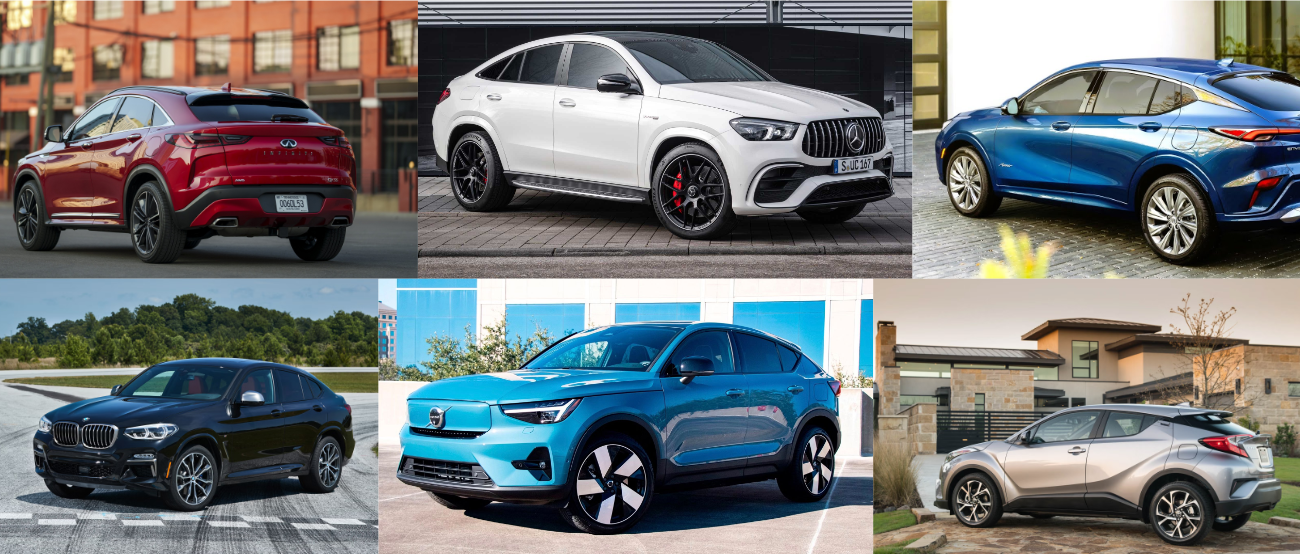
Do all of these examples meet light truck eligibility? No. But it's blatant how much easier it is to make these stilted, snub-nosed Crabs qualify as light trucks compared to a traditional sedan body style.
There's yet one more regulatory carcinization factor to touch upon. NHTSA has a complex analysis process to inform their curves, target values, and general recommendations. It's detailed at length in the Final Rule, if you too wish to suffer through the hours of required reading to understand it in totality. One of the many steps includes assessing the diversity of vehicle species currently for sale across all manufacturers, a.k.a. fleet mix. And what are the classes NHTSA use for this? Only passenger cars and light trucks, of course. Therefore, the higher the ratio of light trucks in the market, the lower the CAFE standards and expectations become. Fleet mix analysis, much like the light truck definition and fuel economy curves, has been more or less unchanged for fifty years.
Boiling The Frog
It goes without saying that 1975's policies weren't written with today's vehicle landscape in mind. The most unique body style of that era was that of the El Camino. Crabs as we see them now didn't exist yet, and there weren't nearly as many species and subspecies of them compared to today. Why does NHTSA recognize and analyze a multitude of vehicle species throughout their process, then insist upon creating standards for only two massive, inaccurate categories? The footprint-based curves somewhat account for size disparity within classes, but do nothing to solve the conundrum of vehicle design broadly shifting to abuse light truck criteria.
Of course, none of this is new information. There are much smarter people than me who get paid to study these matters and lobby the Feds about them, and they've been doing it since long before I came across these hole-ridden, outdated clauses. NHTSA is legally obligated to respond to public comments in the Final Rule. So I read them! Here's one relevant excerpt:
"A coalition of environmental group commenters urged NHTSA to set a 'backstop,' or 'minimum standard below which the actual performance of the fleet may not fall.' The commenters stated that, 'for example, in MY 2019, the most recent year for which information is available, the fleet mix of sedans and station wagons had shifted to only 33 percent of the fleet'[...]As a result of mix shift changes like this, real-world fuel economy has been lower than NHTSA has previously projected."
And what did NHTSA think about this professional observation of carcinization, its effect on measured fuel economy averages, and a proposal to mitigate those effects?
"Unless the backstop was at a very weak level, above the high end of this range, then some percentage of manufacturers would be above the backstop even if the performance of the entire industry remains fully consistent with the emissions and fuel economy levels[...]This could directionally impose increased costs for some manufacturers."
Note how they say it could increase costs, with no specificity given to the extent or detriment. This reeks of protecting the Big Three. Sure, they estimate some costs when explaining their three proposed "alternative" curves and their final decided-upon "two-point-five" curve, but none of those curves impact automakers' profitability because they were all created with their direct consultation. Even if they did, any compliance costs incurred by manufacturers get passed onto consumers in the form of increased MSRP regardless. NHTSA even recognizes that in their analysis by assessing and predicting future vehicle pricing based on various proposed curves. Their stance seems to heavily favor low standards, so that the Big Three can keep failing forwards and maximizing profits. NHTSA goes on to observe:
"At the industry-wide and individual-manufacturer level, then, to the extent that 'backsliding' is occurring, it appears to be the result of trucks and SUVs increasing their share of the market, and sedans and station wagons decreasing theirs. It is not clear to NHTSA at this time that setting minimum standards[...]would meaningfully change this market trend."
How about the light truck definitions themselves? Any comment as to why those have remained unchanged for fifty years? On page 344 they replied, "Over time, NHTSA has refined the light truck vehicle classification by revising its regulations and issuing legal interpretations." Although I didn't go on a wild goose chase to dig up evidence of past interpretations, it is patently false to claim that the regulations have been revised. Interpretations aren't significant either as they typically apply on a per-case basis. They go on to acknowledge that "based on the increase in crossover SUVs and advancements in vehicle design trends, NHTSA became aware of vehicle designs that complicate classification determinations for the CAFE program."
What did they do after attaining such enlightenment? "Throughout the past decade", they "discussed the trend in rulemakings, publications, and with stakeholders", "committed to continue research", and "notified the public of its plans to develop a compliance test procedure for verifying manufacturers' submitted classification data".
Okay, so in the last ten years they've taken no action. What about right now?
"In this final rule, NHTSA is adding additional clarifications for testing production measurements for vehicles with adjustable suspensions and clarifying its intent to collect information from manufacturers for defining current axle and running clearance dimensions for light trucks. [...]We note that we are not changing our current regulations on vehicle classification in this final rule."

Great. Moving on, then. There were also public comments about the relationship between footprint-based curves and manufacturers steadily upsizing vehicles. In response, NHTSA cites a prior investigation which concluded that "passenger car footprints increased by an average of 0.1206 square feet annually over the 2008-2020 period."
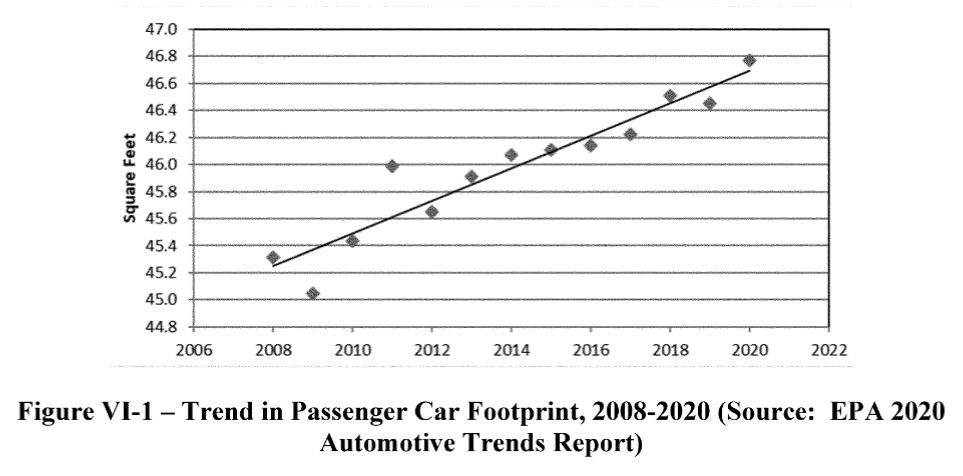
This growth was also stated to be faster than they anticipated. In response to the findings, they applied a 1.9% offset to the Minimum Domestic Passenger Car CAFE Standards a.k.a. MDCPS (everyone point and laugh at the acronym within an acronym). However, they did not adjust general CAFE standards nor did they run a similar analysis on light trucks. If their analytic methods produced inaccurate estimates for passenger cars, why did they trust the ones for light trucks? It seems oddly convenient that they ignored re-evaluating the category that eclipses the market.
It gets even better. Here's a response to public comments on page 267 about increasingly-avoidant manufacturer behavior:
"NHTSA agrees that automakers have been relying more heavily on banked credits for compliance over the last few model years. NHTSA also agrees with the observation that American consumers purchased larger and heavier vehicles, on average, than previously expected. This is evident in the compliance data for both the CAFE and CO2 programs. NHTSA does not agree that automakers reducing passenger car offerings is necessarily due to CAFE stringency, however. The standards were designed to enable automakers to bank compliance credits as a compliance flexibility, and reliance on those banks means automakers are using program flexibilities in order to optimize their compliance strategies and reduce costs."
Author's Note: I'd rather not get lost in the weeds of how banked credits work, as it's only indirectly relevant to carcinization. But in short: corporations can exceed CAFE standards with some vehicles to earn credits that can be spent to avoid paying fines on other vehicles that fail. Credits can be held into the future and spent retroactively. Unbelievably, they can even be purchased and transferred from other manufacturers. If you want to learn more, I encourage you to read both the CAFE Final Rule and that linked CAFE Civil Penalties Final Rule. C'mon, do it! Think of the kind of Facebook comments you'll be able to write.
"There is a chicken and egg question here, in which consumers seek out larger and heavier vehicles when gas prices are relatively low; automakers continue to offer those vehicles—and indeed, market them heavily—and (in some cases) discontinue smaller and more fuel-efficient models going forward; this marketing strategy can and should adjust to facilitate compliance with CAFE standards that were predicated on (among other things) the potential to offer smaller and more fuel-efficient models[.]"
Over the course of these replies, NHTSA recognizes that manufacturers are arguably over-utilizing every aspect of the system yet claim that it's all done to "optimize their compliance strategies". Now would be a great time for a reminder that CAFE's directive is to enact the "most stringent requirements possible" after consideration of a multitude of factors, including financial burden on consumers and corporations. But every single time based on the evidence presented, NHTSA's stance is that any burden whatsoever on automakers is untenable. They can't have it both ways and claim that their policies can only affect market offerings when it's convenient for them to say so. That ship sailed in 1975. We decided then and there that an unregulated vehicle market contributed to a crippling national over-reliance on foreign oil, in part due to poor fuel economy. We decided that increased manufacturer R&D costs would be outweighed by consumer cost-savings from MPG gains. NHTSA even agreed in the 2024-2026 Final Rule that those savings benefits still exist today! In 1975, automakers optimizing compliance strategies resulted in immediate, substantial gains in fuel economy for almost a decade. But in 2025, despite observing that current compliance measures dramatically flatten the curve and minimize fuel economy gains to as little as 0.1mpg year-over-year, NHTSA wants us to believe that CAFE regulations are simultaneously working as intended and unable to affect the market - that there is no need to update the compliance methodology whatsoever.
While we're here, let's invalidate their claim that consumers only buy bigger, thirstier vehicles when gas is cheap. I couldn't find the EPA's average fuel economy values available as raw data, so I estimated using the graph and pulled that in that alongside macrotrend's CPI-adjusted average gas prices.
Author's Note: I needed to use this non-government source to backfill gas prices for 1975, 1976, and 1977. I cross-referenced the values with other third-party sources when possible to ensure accuracy.
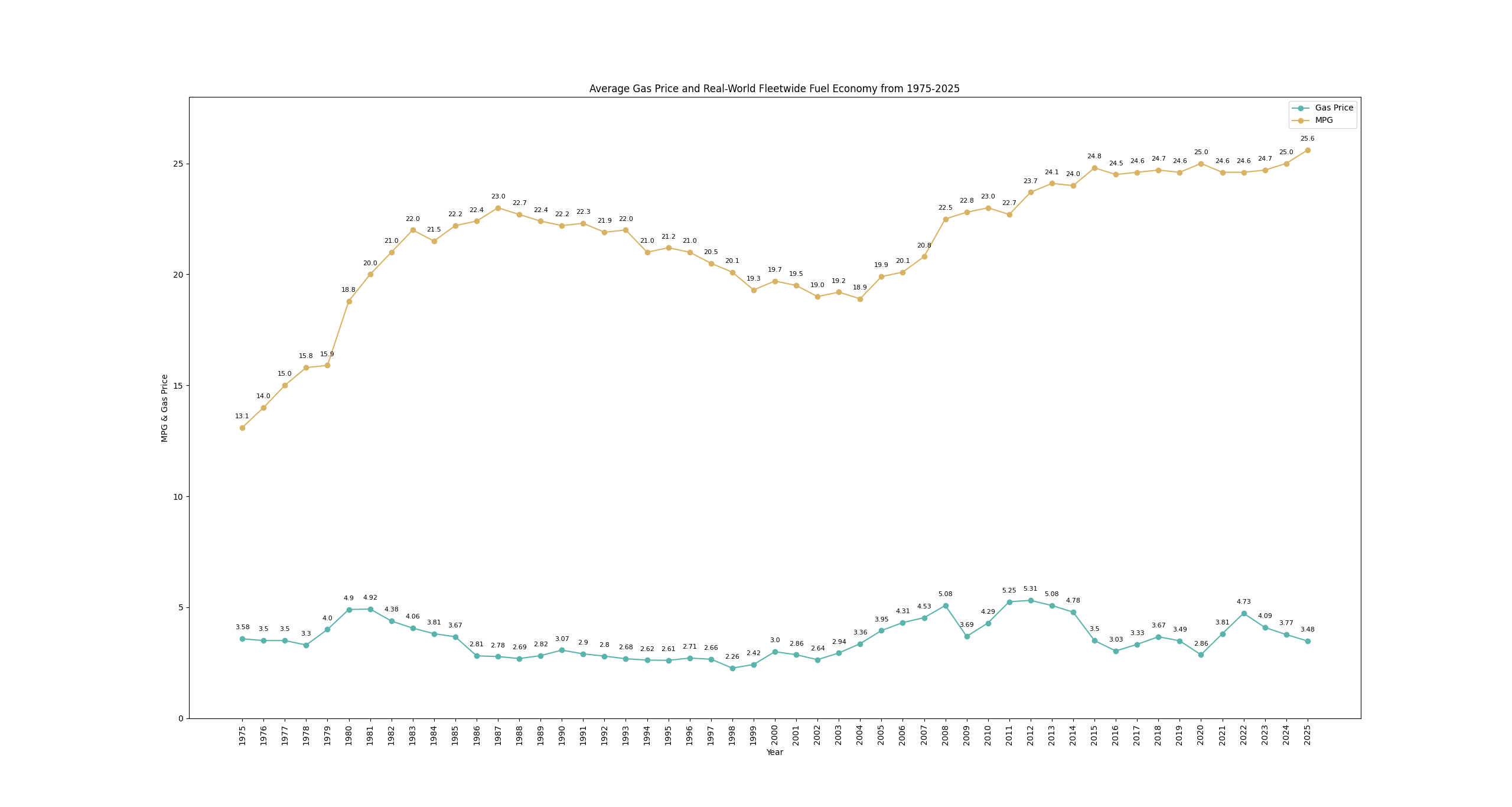
Running a linear regression on the combined dataset, there is no significant correlation (p=0.335) between average fuel economy and average gas price. This in itself is not enough to invalidate their claim, of course - I didn't control for the myriad other factors that affect purchasing behavior or supplier offerings. But what it does say, in combination with my findings of steadily-increasing carcinization and vehicle size over the past thirty years in spite of multiple gasoline and economic crises, is that someone well-versed in data science is well within their rights to run a deeper analysis and call proper bullshit.
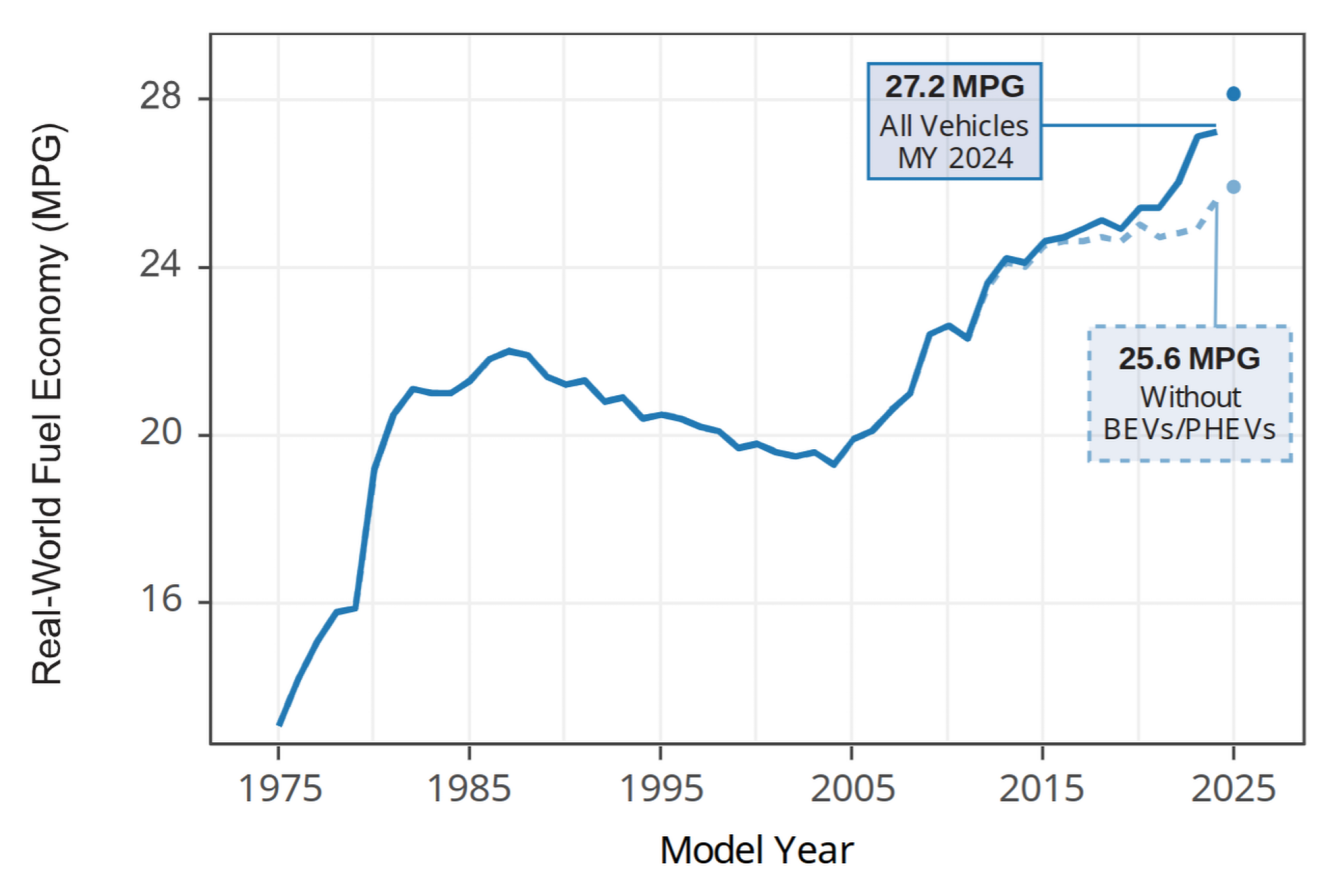
Still think CAFE is working as intended? Above is the EPA's most recent real-world fleet-wide fuel economy data from their 2025 automotive trends report. There's a long period of decline from the late 1980s until the mid 2000s as well as a plateau from 2015-2025 (without BEVs/PHEVs). The former was likely driven by the aforementioned nineties nascent SUV boom; the latter is especially relevant in light of the rising prevalence of hybrids and EVs. From 1975-1985 average fuel economy leapt upwards by about nine MPG, yet from 2015-2025 it barely crawled up by one. You may dispute my exclusion of hybrid vehicles since they technically conserve gas, but I counter with the reality that those gains come mostly from the EV portion of the powertrain. When left on their own, gasser vehicle fuel economy has only risen three MPG in forty years.
It bears clarifying that manufacturers didn't hit a magical engine fuel economy plateau ten years after CAFE's birth due to technological limitations. Hell, Honda's CVCC cylinder head design (whose development was actually spurred by EPA emission regulations five years prior to CAFE) delivered up to forty one highway MPG in a chassis whose driving experience remains lauded by enthusiasts to this day. The engine in today's Honda Civic achieves the same highway MPG and triple the horsepower despite being in a much larger and heavier chassis. The same story is true for most other modern engines. So what have automakers been doing that flattened the fleet averages? As illustrated earlier, once they figured out how to skirt CAFE rules they immediately reverted to their old behavior of maximizing vehicle size and profit margins. Engines may have gotten more efficient, but vehicles got bigger, taller, and more crab-like at a suspiciously-coincidental rate. Every gas engine efficiency gained was converted directly into carcinization, not consumer savings or national energy independence or environmental protection.
But consumers are happy! They love their huge Crabs! Everyone wins, right? Sure, were it not for the fact that no matter how you slice it, maintaining a fleet's average fuel economy is not equivalent to improving it. It seems that despite all our computerization and engine advancements, the single best way to move the needle upwards is still the dead simple trick of the seventies' gas crisis: decrease vehicle size. In today's America? Dream on.
Modern EVs and hybrids are amazing inventions for a lower-carbon future, but mask a dark abuse by manufacturers to avoid improving gas vehicle fuel economy. Imagine the kind of MPG metrics we'd see in an alternate, uncarcinized reality. Imagine the full package of high efficiency, power, and practicality in a gasser or hybrid wagon the size and weight of an '82 Tercel. But NHTSA seems perfectly content with engine efficiency improvements manifesting in minimal-to-zero vehicle efficiency improvements, as long as hybrids and EVs are around to artificially inflate the combined fleet metrics. (Don't even get me started on how worthless MPGe is as a metric for cross-comparison.) Which is very odd considering that they also stated outright:
"If evidence surfaces that manufacturers are, in fact, letting ICE
vehicle fuel economy languish while complying solely (or heavily) with BEV technology, NHTSA would consider this an equity issue and would reevaluate our position on additional minimum standards."
Would they really? So, ten years isn't enough? What's their evidence threshold for finally holding corporations and consumers' waistlines accountable? When Crabs are so bloated that we'll need to increase the minimum weight requirement for a CDL? When median auto loan debt surpasses student loan debt? When our overdependence on oil-based energy bites us in the ass again? According to the history of the Final Rule, all NHTSA has done for fifty years is stare at the curves, nudge them slightly upwards after getting a thumbs up from automakers, and sit on their hands. No definition changes, no classification changes, no loophole closings, no public or regulatory encouragement of smaller, more efficient vehicles. Only repeated blame of manufacturers' and consumers' love of Crabs. If they are still waiting on additional information and data collection as they love to cite throughout their responses as justification for inaction, the American public deserves to know why forty years of data is insufficient. But if I had to guess, NHTSA is probably too busy giving road head to Ford to give us an answer.
As one final insult to injury, the Trump administration's "Big Beautiful Bill" recently gutted the already-paltry CAFE penalties, setting them to $0 (see Sec. 40006 of that document). Setting aside the fact that fines are not an effective means of corporate regulation and are instead simply an added business cost passed directly onto customers, car companies now have no reason to comply with CAFE in any manner whatsoever. If you believe against all evidence presented thus far that the cost savings from deregulation will somehow manifest in the form of lower MSRPs, higher fuel economy, or improved vehicle engineering, you are beyond help.
And thus the frog is boiled. I've already discussed at length the ways in which manufacturers and consumers are culpable for carcinization. But let's be clear: the footprint, light truck, and alternative fuel loopholes in CAFE's decrepit regulations are an equally-direct contributor. Carcinization isn't a trend anymore. For the last six years in a row, every major manufacturer has offered more Crabs than cars for sale. The average offering mix among all makes has hovered around 50% for almost twenty years. The last remaining affordable station wagon for sale in the US, the Subaru Outback, just turned into a Crab for 2026. The only six alternatives are luxury wagons, half of which exceed $100,000. Nobody is buying these. The Crab has been a center-stage cultural icon for almost thirty years. It's shameful of NHTSA to observe and acknowledge how their policies have influenced vehicle species variation and evolution and in the same breath deflect all responsibility onto consumers and the market. Yet, they do. So it goes.
Believe it or not, I didn't go into this project thinking that CAFE regulations could impact vehicle shape and size to such a degree. In fact I assumed the opposite, but the evidence is so abundant it feels satirical. There is one last point to emphasize, though: the concept isn't to blame. CAFE worked well initially and encouraged manufacturers to invest in developing more efficient powertrains. Modern engines are much more efficient and powerful than they were fifty years ago, and CAFE's role in the seventies was a partial contributor to that. Rather, the problem lays in its eventual regulatory capture by manufacturers, most likely our own domestic Crab behemoths known today as Ford, General Motors, and Stellantis. That's an even longer story best investigated by a real journalist, though.
In the end, everyone is guilty. Our government for becoming industry's pay pig, our automakers for skirting regulations and over-marketing Crabs, and ourselves for getting addicted to their allure. Humans don't want to hear that answer. We want simple stories - one victim (us), one perpetrator (them). But it's never that clear-cut. (I'm sure there are even more factors I've overlooked, but I hope this project is a comprehensive start.)
I embarked on this journey to find as many plausible factors as I could until I burned out, to quantify and trace automotive carcinization's history because I was fucking sick and tired of hearing people relentlessly blame each other. Why is everything an SUV now? How did we actually get here? By manifesting it on all sides - supply, demand, and regulation. The road to hell isn't paved with good intentions. It's lobbied for by corporations, paved by the government, and maintained by consumerism.
Epilogue
If you've made it this far, kindly indulge me for one final brief chapter which is more journalistic and less data-driven. Now that we understand why Crabs are so prevalent, I'd like to provide an honest opinion as to why they're so popular.
Early Brass Era motor carriages were largely inspired by horse-drawn carriages. Plush bench seats, tall ride height, wagon wheels and leaf spring suspension all combined into a package comfortable (enough) on the terrain of the early 1900s - be it asphalt, cobblestone, or dirt. They were vehicles intended to get around in all situations except extreme ones. Some were smaller affairs intended for "motoring", but the majority were either two-seat commuter cars or family haulers with room for baggage and kids. Even the commuting-oriented models looked remarkably Crab-like. Vehicles of the 1920s and 1930s followed this trend, optimizing their suspension for tarmac while maintaining a tall ride and carriage body style. They're large, imposing creatures. Even at rest, they look poised to carry you effortlessly.
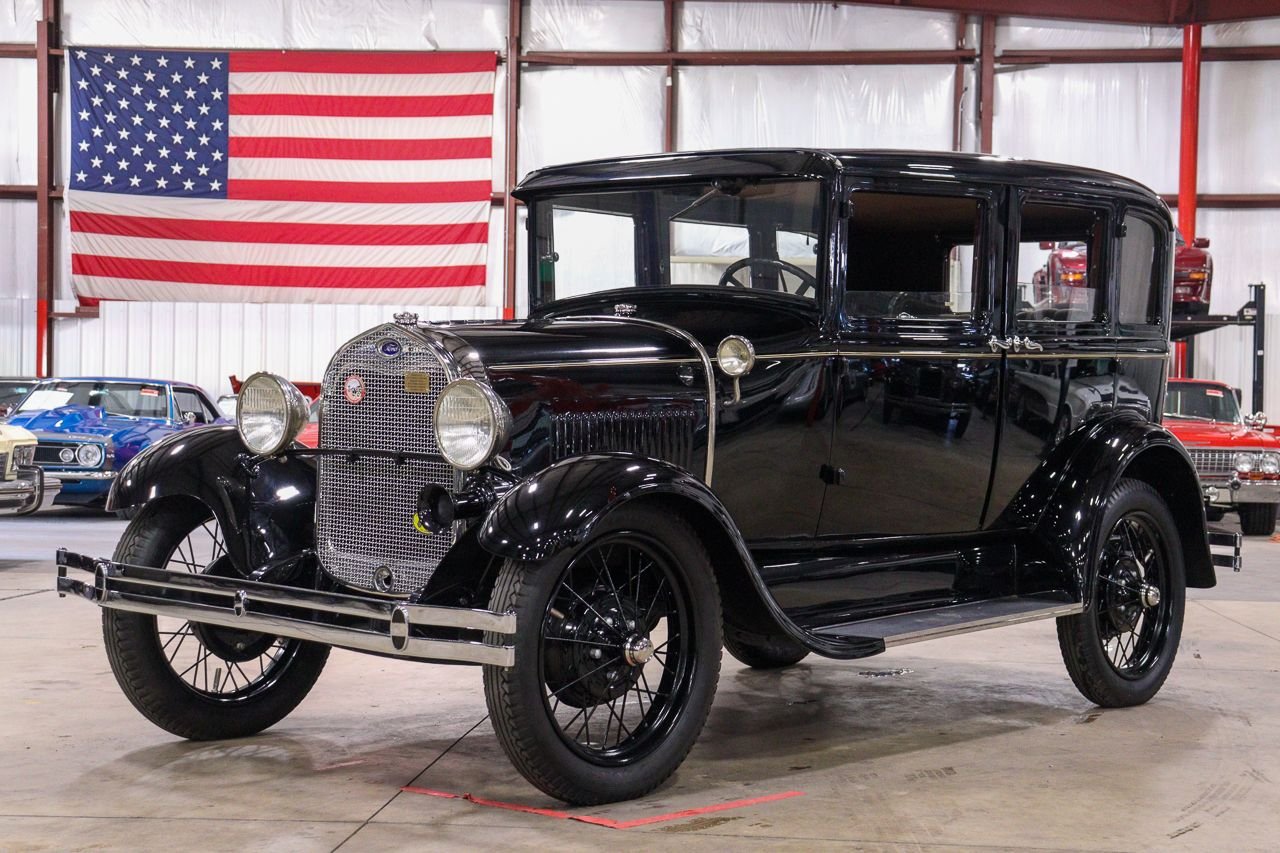
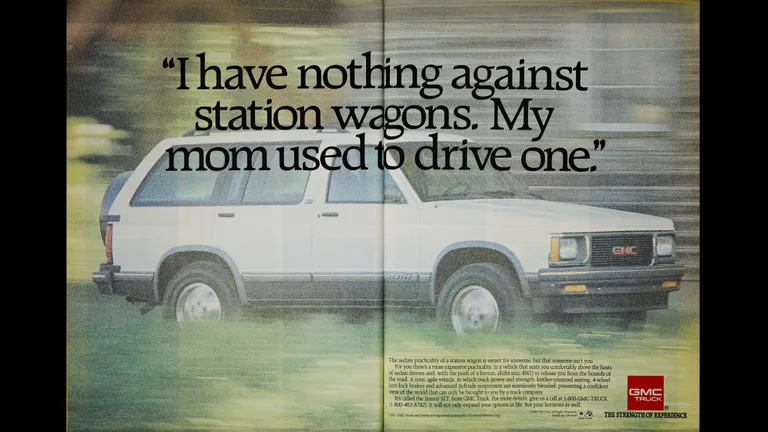
The social reasons for this design's success are much the same as Crabs today. Brands marketed them with appeals to freedom of mobility, convenience, comfort, and human utility. Just look at this 1920s promotional film by General Motors, advertising and catering each of their brands to a segment of the burgeoning vehicle market. Go anywhere! Do anything! Enjoy the luxuries of modernity! Now take a gander at these 1990s paper ads. While the car ads emphasize performance, styling, and affordability, the Crab ads push lifestyles of comfort, convenience, and adventure. Two of them are especially noteworthy:
- GMC Jimmy (1992) fires a point-blank shot at the declining cultural reputation of "mom-mobile" wagons to position the SUV as the cool alternative.
- Mitsubishi Montero (1998) directly calls out Americans' growing habit of buying Crabs and never taking them off-pavement, yet reassures in the subtitle,"Whether it's manhandling rough terrain or stomping through the city, a Mitsubishi Montero will get you where you're going."
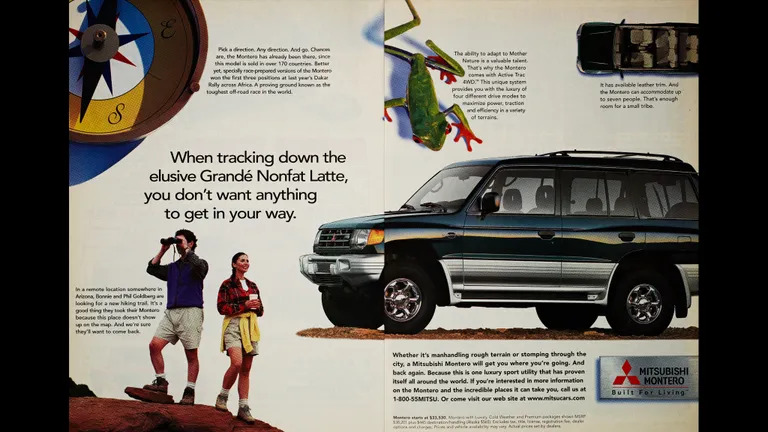
What are Crabs but a heartfelt centennial embrace of the motor carriage? The perfect vehicle for the typical consumer who is unsure of their needs and social standing. Fueled by the maybes of life, the Crab soothes anxieties about the future. What if you have a kid? What if you get really into hiking? What if you need to drive in the snow? What if you need to haul a bunch of shit? What if you want to go on a roadtrip? Buy a Crab, and you won't need to worry about any of that. Hell, you won't even need to think of questions to ask - the Crab will have an answer when the time comes. Sure, there are other vehicle species that are better at certain jobs, but none of them are adequate at every job. And before you criticize people for buying vehicles without considering their realistic needs, remember that we are all typical consumers about something. Maybe it's your phone. Maybe it's your clothes. Maybe it's your cutlery, your TV, your tools, your earbuds, your keyboard, your furniture. There are too many products in the world and too many needs in your life for you to think critically about every purchasing decision. Most purchases are made to solve a nebulous problem in the fastest and easiest way possible. You are not different. I am not different. Consumerism is built on the foundation of peace of mind, otherwise known as convenience. And the Crab is the pinnacle of automotive convenience.
My vehicle ownership is very atypical from the modern norm. I recently moved from a hatchback to a two vehicle solution in the form of a two-door base trim truck and a twenty-five year old sports car. The truck sits around unless I need it for truck duties and the sports car is driven daily as long as it's not snowing. I'm able to invest time into repairing my own vehicles, which helps me afford two of them. I also have a loving husband who lets me borrow his Crab whenever I need its all-weather, all-road, or four-door capabilities (or when the sports car is broken). These privileged circumstances enable me to live every car enthusiast's dream of owning specialized vehicles - one great at hauling shit, one great at moving quick, neither useful for anything else. Every drive is engaging in a unique way. I can fully embrace the truck experience of commanding a large vessel or the sports car experience of darting between traffic.
And yet, I still miss my hatchback. Carrying passengers or personal cargo, driving off-road or in deep snow, and cruising comfortably in traffic are all harder now. Most households can't and/or won't make the necessary lifestyle changes for daily-driving a sports car, two-door truck, or even sedan. There's an argument to be made for wagons, but we collectively decided they were uncool twenty years ago. (Most enthusiasts would bin all but the sportiest among them as Crabs anyway. The only reason we think wagons are cool now is because they lost popularity. You can't change my mind, and you know I'm right.) This problem is amplified by the fact that the vast majority of households only own one or two vehicles, with only 22.1% of households owning three or more like mine. If you can have two vehicles in your household, then maybe you can get away with one specialized vehicle and one Crab. But what if you can only have one? Intentionally buying a less convenient vehicle would be a rejection of consumerism - an acknowledgement of introducing potential stress into your life.
At the heart of all of this, maybe that's the real reason enthusiasts hate Crabs. We're a countercultural bunch, after all. To reject the Crab is to embrace challenge! Bring it on, come what may! We're brave and willing to sacrifice convenience to make the act of driving engaging and enjoyable once more. Or maybe it just feels good to punch down at others who don't view driving the way we do. Others who are just as stressed as we are about making it through life in the American Century Of Humiliation. Others who will do anything (including spending far beyond their means on four-door luxury trucks) to make some of that stress disappear. Anything to ignore the reality that at the end of the day, we enthusiasts are just stupid, contradictory, fearful consumers as well.
I believe the only way out is through. Learn to love the Crab if it suits you. Fun vehicles will always exist at the fringes - the market wants everyone's money, not just the median's. Endorsement of the popular is not rejection of the niche. After reading all this, if you're wringing your hands with guilt and want to improve things somewhat, your best option is to keep driving and repairing the vehicle you already have; or in the event of its death, buy the smallest possible vehicle that meets your needs. Maybe you can start a viral trend of shaming four-door trucks as uncool Karen-mobiles. But I know you don't really want to do any of that. I don't blame you, either. Someday, perhaps we'll wake up in an America with robust public transit that frees the auto industry and consumers alike from carcinization. I'm not holding my breath until then, though.
-anchovie
If you enjoyed this project, please consider supporting the cost of its development. Or buy a sticker!